

Third World Congress of Age-friendly Cities and Communities Will Set Course for Connected, Equitable, and Sustainable World for All Generations
- The first WHO co-sponsored World Congress on age-friendly environments in over 12 years offers a unique opportunity to assess progress and shape the future of the global age-friendly movement
- More than 1,700 cities and communities from across 60+ countries will gather under the theme ‘Transforming Together! An Age-friendly World — Connected, Equitable and Sustainable for All Generations’
- Taking place at the midpoint of the UN Decade of Healthy Ageing (2021–2030), the event will look into how the age-friendly approach can help us address critical contemporary challenges, such as social connection, digital inclusion, equity, and sustainability
- Imserso, Basque Government, the City Council of Donostia/San Sebastián and the Provincial Council of Gipuzkoa organize the Third Congress of Age-Friendly Cities, under the co-sponsorship of the WHO
- The Congress will draw on Euskadi Lagunkoia network, on Donostia/San Sebastian’s local expertise as a pioneer of the age-friendly approach since 2009, and Spain’s national expertise with over 280 cities and communities part of the WHO Global Network for Age-friendly Cities and Communities
- Interested stakeholders can follow the Congress and stay updated on https://www.3wcafcc.org/ and on X, Instagram, Bluesky and LinkedIn at @3rdwafc
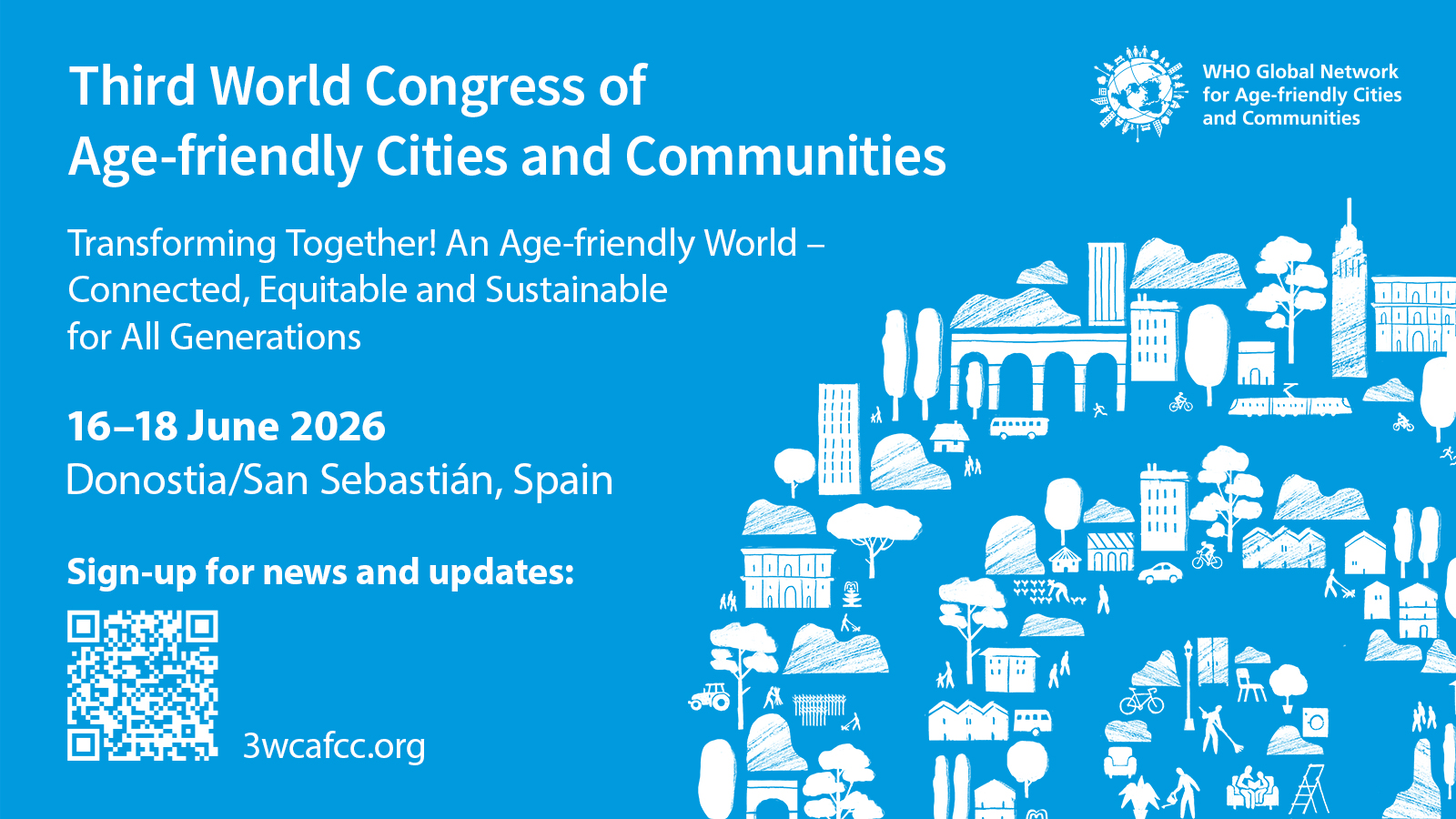
14 November 2025 – The first WHO co-sponsored international age-friendly congress in over 12 years will unite cities, communities, and global leaders in Donostia/San Sebastian (Gipuzkoa, Basque Country), Spain on 16–18 June 2026 under the theme: ‘Transforming Together! An Age-friendly World – Connected, Equitable and Sustainable for All Generations’.
After more than a decade, the WHO Global Network for Age-friendly Cities and Communities – which has grown to over 1,700 members across 60+ countries – is gathering to assess what works, accelerate solutions, and lay the basis to evolve the age-friendly framework for contemporary contexts.
Co-sponsored by the World Health Organization and organized by Imserso in collaboration with the Basque Government, the City Council of Donostia/San Sebastián and the Provincial Council of Gipuzkoa, the Congress will draw on this combination of global, national and local expertise to bring together local representatives, policymakers, researchers, civil society organizations, and older people themselves.
WHY THIS MATTERS NOW
Since the Global Network’s establishment in 2010, the age-friendly movement has strengthened exponentially. At the same time, today’s older adults are facing a rapidly changing global context with multiple intersecting crises – but are also more diverse and have more to contribute than ever before.
The Congress will address this reality head-on through three interconnected themes:
- Connecting Generations, Technology and Care: Bridging gaps between generations, digital divides and primary and secondary care/formal and informal care
- Equitable communities: Ensuring that no one is left behind
- Building More Sustainable Age-Friendly Communities
As the world reaches the midpoint of the UN Decade of Healthy Ageing (2021–2030), this Congress offers a unique opportunity to re-shape how communities worldwide respond to population ageing by celebrating the past of this global movement, meeting present challenges, and embracing future opportunities.
WHAT PARTICIPANTS WILL GAIN
Whether participants are already transforming their community or just beginning to explore the age-friendly approach, this Congress will:
- Celebrate progress and learn from experience: Reflect on the achievements of the age-friendly movement over the past 15 years, highlighting key successes and lessons learned to guide the path forward.
- Foster connections and inspire action: Bring together individuals and institutions to exchange ideas, showcase impactful and implementable initiatives and practices across all age-friendly domains – locally, nationally, globally, in academia, and in business.
- Shape the future of age-friendly cities and communities: Create a space to collaboratively define a bold vision for the future, incorporating emerging priorities and identifying concrete steps to integrate and accelerate age-friendly policies, practices, funding, and research worldwide.
SPAIN’S LEADERSHIP – AND A FITTING HOST CITY
Donostia/San Sebastian, capital of the province of Gipuzkoa, in the Basque Country, pioneered age-friendly approaches in Spain, becoming the country’s first Global Network member in 2009 and creating a diagnostic framework that remains a national benchmark. Today, Spain has more than 280 Network member cities and communities – 63 in the Euskadi Lagunkoia Network, in the Basque Country – demonstrating how national commitment accelerates local transformation. And with Spanish-speaking cities and communities leading the way on the age-friendly movement, there is no better country and city to host this opportunity for international exchange and community-building.
JOIN THE CONGRESS AND THE AGE-FRIENDLY MOVEMENT
For existing members of the age-friendly community and the Global Network, the Congress provides a unique platform to showcase proven practices, connect with peers facing similar challenges, and access cutting-edge research and policy innovations. Members will engage in knowledge exchange that can be immediately applied in their own communities, while contributing to the global evidence base.
For stakeholders newer to the age-friendly approach, this is an unparalleled opportunity to understand the WHO framework in action, learn from cities and communities that have successfully transformed their environments, and discover pathways to joining the global movement. The Congress will demonstrate what is possible when communities commit to becoming more age-friendly for people of all ages.
For more information visit: https://www.3wcafcc.org/
Follow the conversation: X, Instagram, Bluesky, LinkedIn (@3rdwafc)
ABOUT THE WHO GLOBAL NETWORK FOR AGE-FRIENDLY CITIES AND COMMUNITIES
Established in 2010, the WHO Global Network for Age-friendly Cities and Communities brings together more than 1,700 cities and communities in over 60 countries committed to making their community a great place to grow older in. Membership reflects a commitment to listen to older people’s needs, assess and monitor age-friendliness, work collaboratively across sectors, and share experiences with others. Learn more at https://extranet.who.int/agefriendlyworld/.