
Adding life to years
Text size:
-+=

Letnjikovac (Šabac) intergenerational walking trail
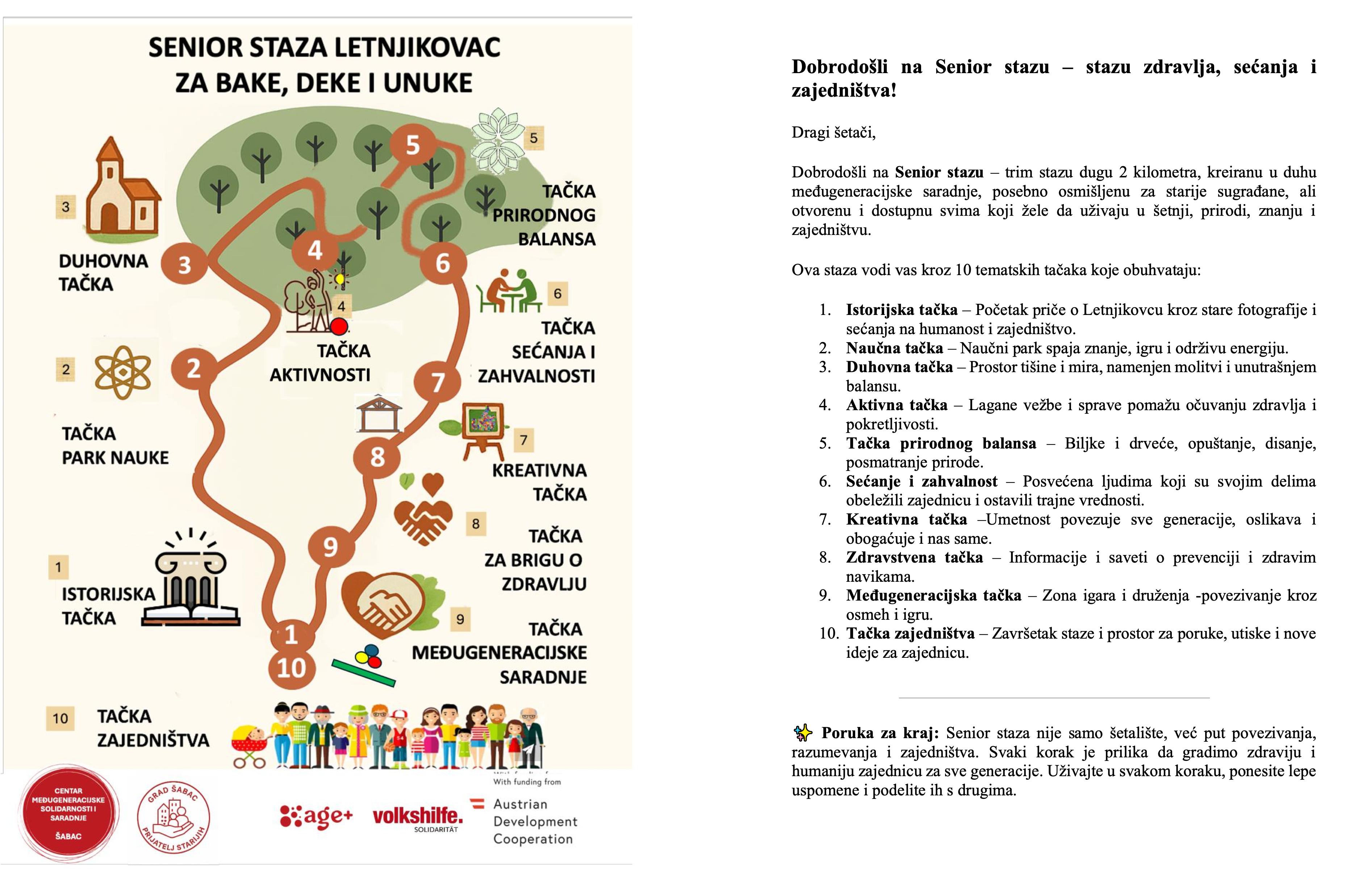

Letnjikovac (Šabac) intergenerational walking trail

Summary

The Letnjikovac Intergenerational Walking Trail was created to promote healthy ageing, social inclusion and intergenerational solidarity by transforming a public park into an accessible, inclusive and climate-responsive community space. Rather than being designed solely as a recreational path, the trail encourages meaningful interaction between older people, children and families while supporting physical activity, lifelong learning and community participation. The practice was developed within the AGE+ Programme through a participatory co-creation process involving the City of Šabac, the Centre for Social Work, preschool institutions, civil society organisations, urban planners, health professionals and older citizens. Older people actively participated in assessing needs and co-designing the trail, contributing to decisions on walking distances, resting areas, educational content and accessibility features. The initiative was further strengthened through cooperation with the NONA Project and the New European Bauhaus principles, integrating healthy ageing with sustainable, climate-responsive and inclusive public space design. The trail includes thematic stations that encourage physical activity, intergenerational learning, environmental awareness and social interaction. The trail features a historical interpretation point, thematic learning stations, an outdoor classroom and bocce court, creating multifunctional spaces. It has become part of the regular educational programme of the Centre for Professional Development, ensuring its long-term use beyond the project period. Beyond its physical infrastructure, the trail has generated a measurable social return by strengthening social cohesion, reducing isolation among older people, increasing opportunities for volunteering

Website: https://www.facebook.com/profile.php?id=61568697056191

Key facts

Main target group: Both younger and older people (i.e. intergenerational)

Sector(s): Education, Health, Information and communication, Social protection, Urban development

Desired outcome for older people:
Build and maintain relationships

Other issues the Age-friendly practice aims to address:
  • Ageism
  • Ageing in place
  • Elder abuse
  • Healthy behaviours (e.g. physical activity)
  • Intergenerational activities
  • Inequities
  • Inclusion
  • Participation

Contact details

Name: Jelena Milošević

Email address: projektigradsabac@gmail.com


Age-friendly practice in detail (click to expand):

Engaging the wider community

Project lead: Local authorities

Others involved in the project:
  • Civil Society Organisation
  • Older People’s Association
  • Social or health care provider
  • Volunteers
  • Private sector

How collaboration worked: The practice was delivered through a multi-level partnership coordinated by TARA International Consulting (TARA IC). TARA IC designed the 3R model – Respond, Recover and Reform as the programme’s implementation framework. The model responds to community needs through participatory evidence gathering, recovers by strengthening local capacities, resilience and intergenerational cooperation, and reforms by integrating age-friendly principles into governance, public services, urban planning and municipal policies. This enables communities to move from short-term interventions to long-term, systemic change Implementation was based on close cross-sector collaboration between the City of Šabac, the Centre for Social Work, preschool institutions, civil society organisations, older people’s associations, urban planners, public utility services, health professionals and community volunteers. Through regular coordination meetings, participatory planning workshops and joint monitoring, partners shared responsibilities and ensured that the Walking Trail reflected locally identified needs while becoming integrated into existing community programmes. The practice was further enriched through synergies with the NONA Project and the New European Bauhaus initiative, combining healthy ageing, intergenerational solidarity, climate-responsive public space and sustainable urban development. The initiative was co-financed by Volkshilfe Solidarität and funded by the Austrian Development Cooperation, while its long-term sustainability was secured through municipal budget commitments and integration into regular institutional programmes. Collaboration with the Commissioner for the Protection of Equality and the Republic Institute for Social Protection strengthened policy uptake, professional standards and the transfer of age-friendly practices to other municipalities.

Older people’s involvement: Older people were involved in the age-friendly practice at multiple or all stages

Details on older people’s involvement: Older people are not passive beneficiaries but equal partners throughout the process. They participate in needs assessments, co-designed the Walking Trail and other interventions, serve on the Senior Citizens’ Council, monitor implementation and continue to initiate and lead intergenerational activities, ensuring that the practice reflects real community needs and remains locally owned.

Moving forward

Has the impact of this age-friendly practice been analysed: No

Do you plan to evaluate your age-friendly practice? No

Feedback:
Feedback from the target groups has been a key element in developing and improving the practice. Older people actively contributed through consultations, Senior Citizens’ Council meetings and participation in the design of the Intergenerational Walking Trail. The feedback has been strongly positive, particularly regarding the importance of creating an accessible and welcoming public space that supports physical activity, social interaction and meaningful contact between generations. A particularly valuable aspect was the decision to develop the trail in Letnjikovac, a place of historical significance and shared community memory for different generations in Šabac. Transforming such a space into an intergenerational area strengthened the connection between past experiences, present community life and future generations. The strongest confirmation came through participation: on the first beautiful spring days, more than 300 older and younger citizens joined the Intergenerational Walk organised on the occasion of the International Day of Intergenerational Solidarity 2026, demonstrating strong community interest and ownership. Participants emphasised the importance of having a place not only for walking, but also for meeting, learning and sharing experiences. Feedback also highlighted the need for continued maintenance, promotion and regular activities. The main lesson learned is that age-friendly spaces create the greatest impact when they are co-designed with communities and build on local identity, history and shared values.

Expansion plans:
The 3 year AGE+ framework programme was granted a 3 year sequel, AGE+ II. We continue with accredited trainings. – Deepening in the Age Friendly principles – Training of AGE+ coordinators and facilitators of intergenerational activities in cities and municipalities Šabac profiles as an AFCC-model and AFCC promotor for the Western Balkan,

Looking back

Reflections:
One of the most important lessons learned is that creating an age-friendly public space is only the beginning—its long-term value depends on continuous community engagement and institutional ownership. While the co-design process successfully involved older people from the outset, we realised that even more time could have been invested in engaging younger generations, families and local businesses in shaping and animating the space. If we were to implement the practice again, we would place greater emphasis on involving climate and urban planning experts at an earlier stage to strengthen the integration of healthy ageing, environmental sustainability and resilient public space design. We would also establish a more systematic framework for measuring long-term outcomes, including changes in physical activity, social participation, wellbeing and intergenerational relationships. Another important reflection is that age-friendly initiatives create the greatest impact when they are embedded within existing institutions rather than implemented as stand-alone projects. The success of the Walking Trail confirmed that combining co-creation, local ownership and cross-sector partnerships leads to sustainable change. Our experience has reinforced the importance of viewing older people not as beneficiaries, but as partners and innovators whose knowledge and life experience improve the quality and relevance of community solutions.

Challenges:
One of the greatest challenges was implementing an age-friendly approach in a context where no comprehensive national framework or coordinated policy support yet existed. Rather than relying on established procedures, the programme had to build local ownership, institutional commitment and cross-sector cooperation from the ground up. Another challenge was changing perceptions of ageing and demonstrating that age-friendly public spaces should be designed with older people rather than for them. This required bringing together local government, social welfare, education, urban planning, civil society, professionals and citizens with different perspectives and priorities. These challenges were addressed through a balanced combination of bottom-up and top-down approaches. Older people, families and community organisations actively co-designed solutions, while local authorities embedded successful practices into policies, municipal budgets and institutional programmes. At the same time, collaboration with national institutions, including the Commissioner for the Protection of Equality and the Republic Institute for Social Protection, helped strengthen professional standards and support wider policy uptake. The most important lesson learned is that sustainable age-friendly development cannot rely on community participation or institutional leadership alone. Lasting change requires combining local innovation, political commitment and national advocacy so that successful local practices become part of broader governance and policy systems.