

Share your age-friendly practices: Enhancing older people’s rights
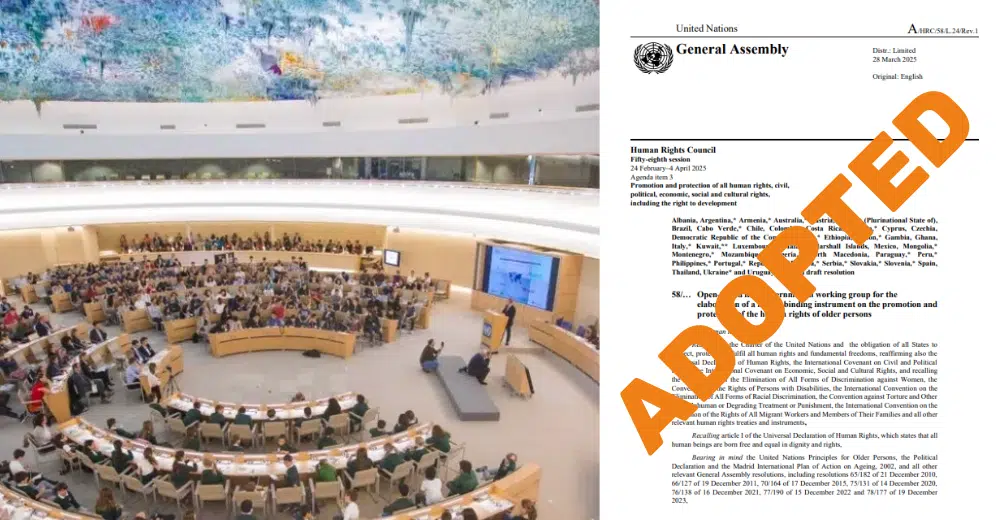
On 3 April 2025, the UN Human Rights Council adopted a resolution to establish an intergovernmental working group to prepare a draft UN convention on the human rights of older persons.
This resolution represents a decisive step towards the adoption of a legally binding international treaty to strengthen and protect the rights of older persons worldwide. Although the term human rights is not commonly used within the framework of age-friendly cities and communities, the way this agenda has been developed and implemented actually aligns closely with a human rights-based approach to ageing. To take a couple of examples:
- The first guide on age-friendly cities published in 2007 insists on a bottom-up participatory approach and the meaningful engagement of older people. Similarly, a rights-based approach prioritises and facilitates the genuine participation of older people.
- The renewed guide published in 2023 highlights: “Cities and communities that are working to be better places for older people to live can help address ageism”. A UN Convention on older persons’ rights would prohibit age discrimination in law, reinforcing this vision globally through legally binding commitments and monitoring.
Beyond the rights to social and political participation, Age-Friendly Cities and Communities actually help protect and promote the right to health, the right to autonomy and independence, the right to housing, etc.
AGE wants to know about concrete measures or initiatives that your community, city, region or country has put in place and how these contribute to the human rights of older people. This information can contribute to the UN Convention’s drafting process, particularly inmaking sure that the lived realities of old age are adequately reflected in the proposed human rights framework.
AGE wants to hear from you:
(1) What is your city or community doing to protect the rights of older people, e.g. in relation to access to housing, employment, social protection, healthcare?
To guide you, here are some concrete examples:
- Wales (UK): the Older People’s Commissioner is promoting and safeguarding the rights and interest of older people in plenty of different domains such as public transport, access to care, elder abuse, access to services in the context of digitalisation. More information here.
- New York City (USA): the Older People’s Commissioner oversees the work of the Department dedicated to ageing issues by fighting against ageism, supporting ageing at home as well as community-based care services and by managing services linked to employment, support to victims, etc. More information here.
- Heredia (Costa Rica): The Municipality Program for Older Persons is committed to the promotion and protection of older persons’ rights through the development of innovative long-term care and support programs, accessible physical spaces and increasing services to older persons vulnerabilised by intersectional inequalities. More information here.
Please share your own experience by submitting a practice in the global data base of age-friendly practices.
(2) What concrete steps did your city or community take to combat ageism?
To guide you, here are some concrete examples:
- Akita (Japan): Akita’s Third Age-Friendly City Action Plan 2022–2026 promotes mutual understanding and respect between generations through education, intergenerational exchanges, and community volunteering, encouraging positive public attitudes toward ageing, recognising older persons’ contributions to local life, and fostering inclusive participation in civic and social life. More information here.
- Monash (Australia): Through its Age-Friendly Monash Plan 2021–2025, the city advances ongoing efforts to combat ageism through community engagement in education initiatives, advocacy campaigns, staff training, and intersectoral partnerships to challenge stereotypes, prevent elder abuse, and enhance civic participation of older adults. More information here.
Please share your own experience by submitting a practice in the global data base of age-friendly practices.
(3) Tell AGE if you are interested in helping us raise the voice of older people within the drafting process of the UN Convention:
- by engaging your local, regional or even national community (e.g. Council of older people, local support group) in the drafting process;
- and/or by partnering with other organisations involved in this process in your country.
Contact person: Julia Wadoux, julia.wadoux@age-platform.eu
Thank you for sharing your experience!