
Adding life to years
Text size:
-+=

The Albany Song Story Project

The Albany Song Story Project

Summary

The Albany Song Story Project was a multi-phased, inter-generational project to bring high school students together with older adults to interview them. The students would ask older adults if there was a song that instantly took them back to a special memory in their lives, they would then record these ‘song stories’.

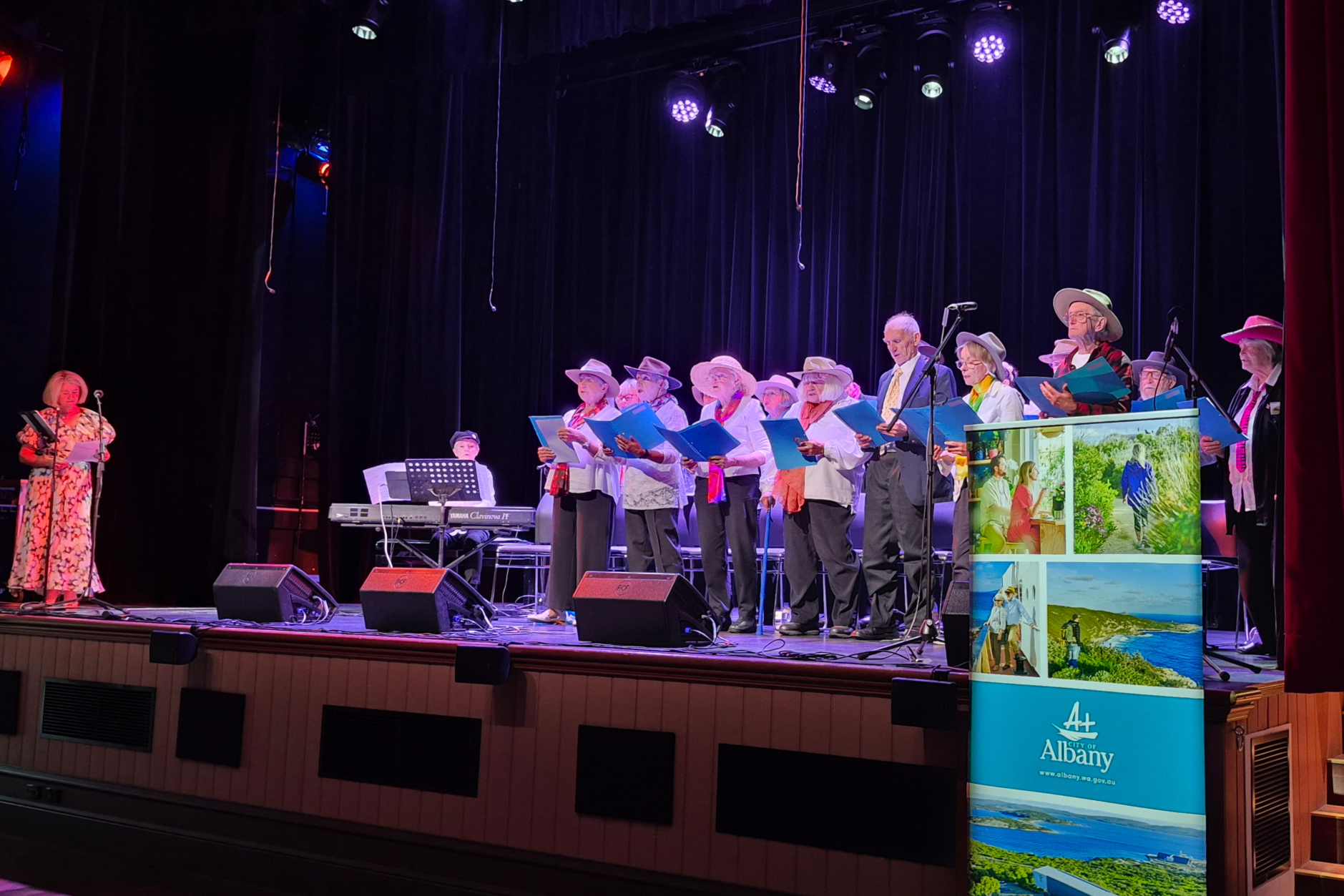
Then, later in the year, the project worked collaboratively with the private sector musical groups, community musical groups and school musical groups to organise a free concert for all older adults and students that took part in the initial phase. This concert would perform the songs back to the audience with the ‘song stories’ interweaving the songs together.

The concert has over 180 people in attendance to hear from Professional musical groups, community musical groups (including a seniors choir), and school choirs, then discuss the concert, the songs, and the memories over a free lunch. The project received strong favourable media coverage, extremely positive feedback from both the older adults and the students that took part, and very positive public feedback.

We have since organised several legacy concerts as a result of this project and foresee it continuing in future.

Website: https://youtu.be/LBCtpU8Ty6M?si=8c6vfggDcdDWBAr1

Key facts

Main target group: Older people in general

Other target group(s): Seniors in Aboriginal Communities

Sector(s): Social protection

Other sector(s): Socially isolated, Lonely

Desired outcome for older people:
Contribute

Other issues the Age-friendly practice aims to address:
  • Ageism
  • Dementia
  • Intergenerational activities
  • Inclusion
  • Participation

Contact details

Name: Evans, Ross

Email address: ross.evans@albany.wa.gov.au

Preferred language(s): English & Welsh

Age-friendly practice in detail (click to expand):

Engaging the wider community

Project lead: Local authorities

Others involved in the project:
  • Local authorities
  • Civil Society Organisation
  • Older People’s Association
  • Social or health care provider
  • Volunteers
  • Private sector

How collaboration worked: The project was led by the City of Albany (Local Authority), they worked with aged care providers, seniors groups, and schools to organise groups of students to attend aged care residences, seniors group meetings and popular meeting places to interview seniors on their ‘song stories’. The City of Albany then worked with professional musical groups, schools, and community musical groups to hold a concert where these songs and the stories connected to them would be played back to the seniors and their families at a free concert. The attendees would then be able to meet and talk with the performers, socialise and have a good old chinwag over a hearty lunch

Older people’s involvement: Older people helped to implement the age-friendly practice

Details on older people’s involvement: The City of Albany worked closely with seniors from the Sunset Singers (Albany’s seniors choir), The Albany Over 50s Club and many aged care providers to develop elements of the project and ensure that seniors were at the forefront of the project.

Moving forward

Has the impact of this age-friendly practice been analysed: Yes

Was the impact positive or negative:
Positive

Please share with us what you found in detail:
The intended outcomes of this project were mostly surpassed, there were a couple of areas that we would have preferred to have been better addressed, but due to the time constraints (within funding parameter timeframe) were unavoidable. The ultimate aim of the project, “to engage with and include seniors in the telling of their own stories to the wider community”, was met and surpassed, by even the best expectations of the initial planning. Marked against the original evaluation tolls outlined in the project plan:  the number of seniors engaged with, was a guide of 100 seniors as a minimum being interviewed. – Well over 100 seniors interviewed, with more than 40 submitting a Song Story  A minimum of 10 Song Stories collected. – Over 40 completed Song Stories collected  The number of community and school musical groups involved in the performances, with a guide of 8. – Only 3 school / community groups involved with the performance  Pre, peri and post surveys to gauge if there has been a decrease in the participant’s social isolation. – Undertaken and will have follow up surveys with participants to see if continuing relationships are built  The number of community and school musical groups that develop ongoing relationships to perform with seniors’ groups, with a guide of 4 as a minimum. – This will be monitored and assessed as we proceed  Two legacy concerts have led to over 60 students visiting, talking with and performing for seniors – Two legacy concerts held successfully, will monitor to ensure this endures going forward

Evaluation report: Albany-Song-Story-Project_Evaluation.pdf

Feedback:
Feedback for the project was extremely positive from participants, performers, students, and the community

Expansion plans:
Yes, this project, will continue with legacy elements from the initial planning will continue with the groups involved in the Albany Song Story Project, and additional ones that could not take part initially due to time constraints, continuing the partnerships with many of the residential aged care providers that took part in the project. This was key to developing the legacy concerts and will hopefully continue to bear fruit.

Looking back

Reflections:
If the project were to be replicated, a longer time period would be highly recommended. You could replicate the project without the involvement of the SongStory Project team; however, if you were to do this, the concert would likely just be a musical one, without the storytelling – unless this was organised as a well-significant undertaking.

Challenges:
The main challenge in hosting events like this was finding a suitable venues that could accommodate both the performers and a large crowd, while also being accessible to seniors, many of whom were in wheelchairs. Another large challenge was due to the time constraints by the parameters of the funding stream, the Age-friendly Communities Connectivity Grants Program 2023-2024, the project needed to be conducted between December 2024 and May 2025, with the acquittal due by the end of May 2025. I did not anticipate this being such a significant issue as it turned out to be. With the summer break period spanning the project’s first two months, the project had a window of just over 3 months to be completed, as a significant aspect of the project involved schools and the community, both of which were on summer holidays. Whilst the project was a success, I would’ve liked a lot more involvement from the schools, and school choirs. If this project is replicated in the future, the recommendation would be to hold it over a much longer time period (one year plus would be ideal), as this would allow the schools to be involved and the possibility of building a community choir just for the project. One way we worked around the issues surrounding the timeframe (see above) was by creating an online portal on the City’s website where members of the public could submit their own ‘Song Stories’.