
Adding life to years
Text size:
-+=

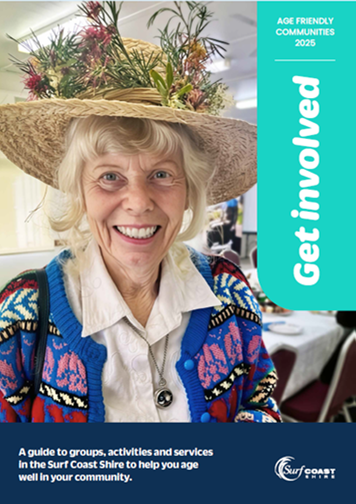
Get Involved – a guide to groups, activities and services

Get Involved – a guide to groups, activities and services

Summary

Council plays a pivotal role in supporting communities where people of all ages, regardless of ability or life stage, can live a quality, engaged and meaningful life. The Get Involved booklet, originally developed in 2021 connects older community members (aged 55+) with local clubs, groups, and activities. Council formally transitioned out of aged care service delivery in October 2021 and aged care assessment in June 2024. To assist the community during this period of transition and in navigating ongoing aged care reforms, Council funded a 12-month Community Connector role. This role was established to support community to navigate the transition and aged care reforms.

As the Community Connector role is time-limited, the Get Involved booklet aims to provide a lasting, accessible resource to help older adults find and engage with relevant services, programs, and opportunities within their local area.

The aim of the Get Involved booklet is to connect older adults with local clubs, groups, and activities that foster social connectedness, enhance physical activity, and promote overall health and wellbeing. By providing accessible and up-to-date information on opportunities for engagement, the booklet seeks to empower older adults to participate actively in their communities, reduce social isolation, and support a vibrant, inclusive, and healthy lifestyle.

Project Benefits Include:
– Capturing local community opportunities for older adults aged 55 and over
– Providing varied information sources to support equitable access
– Increasing community awareness of opportunities, including among key stakeholders involved in social prescribing
– Building community capacity to reduce isolation, maintain or improve functional ability, and strengthen social connections

Website: https://www.surfcoast.vic.gov.au/Community/Positive-Ageing/Age-Friendly-Communities/Staying-Active-and-Connected

Key facts

Main target group: Older people in general

Other target group(s): Older people who are recent retirees, recently relocated or socially isolated

Sector(s): Health, Housing, Information and communication, Social protection

Other sector(s): Civic Participation and Employment; Respect and Social Inclusion; Social Participation

Desired outcome for older people:
Build and maintain relationships

Other issues the Age-friendly practice aims to address:
  • Accessibility
  • Ageing in place
  • Healthy behaviours (e.g. physical activity)
  • Intergenerational activities
  • Inclusion
  • Participation
  • Technologies

Contact details

Name: Rose Salvo

Email address: rsalvo@surfcoast.vic.gov.au


Age-friendly practice in detail (click to expand):

Engaging the wider community

Project lead: Local authorities

Others involved in the project:
  • Older People’s Association
  • Volunteers

How collaboration worked: Collaboration was central to the success of this age-friendly practice. The project was led by Surf Coast Shire Council, which provided overall governance, project management, and coordination. A collaborative approach brought together Council staff, community organisations, health services, and older community members to ensure the initiative was responsive to local needs. Project management was overseen by Surf Coast Shire Council, which managed timelines, facilitated regular meetings, and served as the central point of contact for all partners. Clear roles and responsibilities supported effective coordination, with partners contributing to community consultation, content development, and promotion of the resource. The Council’s Positive Ageing Advisory Committee was a major collaborator throughout the project. The Committee provided valuable guidance informed by lived experience, contributed to shaping the content and accessibility of the booklet, and played a key role in distributing the resource across the community. Their involvement ensured the booklet was relevant, inclusive, and well-targeted to older residents. Funding was supported through Surf Coast Shire Council with in-kind contributions such as staff time, expertise, and distribution support significantly enhancing project delivery. Collaborative planning helped maximise available resources and align funding priorities with community needs. Overall, this collaborative model strengthened partnerships, enhanced community engagement, and supported the successful and sustainable delivery of an age-friendly initiative.

Older people’s involvement: Older people were involved in the age-friendly practice at multiple or all stages

Details on older people’s involvement: The final booklet reflects community needs and preferences, with input from the Positive Ageing Advisory Committee (PAAC) and local stakeholders during the drafting and review process.

Moving forward

Has the impact of this age-friendly practice been analysed: No

Do you plan to evaluate your age-friendly practice? Yes

Feedback:
The community response to the Get Involved Booklet is largely positive. People feel encouraged, welcomed, and motivated by the message. With clearer practical guidance, stronger local representation, and improved structure, the booklet has strong potential to become a powerful tool for increasing community participation and engagement.

Expansion plans:
No, but we do plan to update and continue to improve the resource if and when it becomes necessary.

Looking back

Reflections:
Reflecting on our experience, one key learning was the importance of allowing sufficient time for consultation, review, and distribution. While engagement with partners and older community members was highly valuable, these processes often took longer than anticipated. In future projects, we would build in more time upfront to support meaningful participation and avoid time pressures later in delivery. We also recognised the need to better anticipate the challenges associated with maintaining up-to-date information. Community activities and contacts change frequently, and ensuring accuracy requires ongoing coordination. If undertaking the practice again, we would explore systems or partnerships that support regular updates and long-term sustainability of the resource. Another reflection was the importance of accessibility in both format and distribution. This needs to be considered early in the process to ensure broader reach from the outset. If we were to deliver the resource again, we would place greater emphasis on early planning for sustainability, including clearer ownership for updates, stronger promotion pathways, and evaluation measures to track usage and impact over time. Overall, the experience reinforced the value of collaboration, lived-experience input, and flexible planning in delivering meaningful age-friendly initiatives. The idea to launch the booklet on Ageism Awareness Day and during Positive Ageing Month was intended to encourage people to reflect on how we can all challenge ageism and help build inclusive, age-friendly communities.

Challenges:
Several challenges were encountered throughout the delivery of the age-friendly practice, many of which related to timelines, information management, and stakeholder engagement. One key challenge was managing project timelines. Consultation, content review, and approvals often took longer than anticipated due to competing priorities across partner organisations. This was addressed by adjusting timelines where possible, maintaining regular communication with contributors, and prioritising critical tasks to ensure the project continued to progress. Engaging organisations and securing timely responses was another challenge. Some groups had limited capacity or were slow to respond to requests for information. To address this, follow-up communications were used, deadlines were clarified, and support was offered to simplify the process of providing information. In some cases, publicly available information was verified and used to minimise delays. Changing contact details and program information presented an ongoing challenge, as community offerings frequently evolve. This was managed through a final verification process prior to publication and by clearly noting the publication date, along with guidance on how users could seek the most current information. Privacy considerations also required careful attention, particularly when publishing contact details. Consent was sought from organisations before inclusion, and only appropriate, publicly available contact information was used to ensure privacy and compliance with relevant policies. Finally, categorising activities in a way that was clear and meaningful for older adults required thoughtful consideration. This was addressed through consultation with the Positive Ageing Advisory Committee, whose feedback helped refine categories, improve clarity, and ensure the booklet was user-friendly. Overall, these challenges highlighted the importance of flexibility, clear communication, and strong governance in delivering age-friendly initiatives.