Adding life to years
Text size:
-+=

Summary

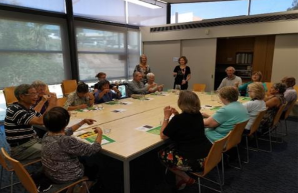
BrainFit is a fun and engaging weekly cognitive exercise programme for adults. This social programme is offered during each week of the term and the topics vary from week to week to keep our minds interested and active. Each session is approximately one hour in duration and consists of four parts: (1) introduction/new brain research, (2) finger coordination exercises/chair yoga, (3) session content, and (4) concluding meditation. It takes place at Warkworth Library each week, and was developed by library staff. They saw a need in the community for a programme that was designed for adults and could be accessed and enjoyed by people with dementia also.
The structured sessions include origami, tangram puzzles, lateral thinking games, brain teasers, whodunnits and ethical dilemmas. BrainFit offers a safe, nonjudgemental social space. It is accessed regularly by about 20 people, the majority of whom are older. Several couples attend where one partner has dementia. The programme could be rolled out in libraries across Tāmaki Makaurau Auckland in the future.

Website: https://www.aucklandcouncil.govt.nz/plans-projects-policies-reports-bylaws/our-plans-strategies/topic-based-plans-strategies/community-social-development-plans/Pages/age-friendly-auckland.aspx

Key facts

Main target group: Older people with chronic health conditions or disability

Other target group(s): People with dementia, lonely older adults

Sector(s): Health, Information and communication, Other

Other sector(s): Social participation

Desired outcome for older people:
Build and maintain relationships

Other issues the Age-friendly practice aims to address:
  • Dementia
  • Healthy behaviours (e.g. physical activity)
  • Inclusion
  • Participation

Contact details

Name: Joanna Maskell

Email address: Joanna.Maskell@aucklandcouncil.govt.nz


Age-friendly practice in detail (click to expand):

Engaging the wider community

Project lead: Local authorities

How collaboration worked: Older adults in the community spoke to library staff, and asked for a specific programme aimed at older people, as library sessions offered were only for children at the time. The programme was developed by library staff and tested by groups of older adults before implementation.

Older people’s involvement: Older people were consulted during the planning process

Details on older people’s involvement: The programme was requested by older people in the community in response to their perception there was a gap in provision of programmes for older adults in the library. After library staff developed the programme it was tested as a pilot in 2020 with a group of older people at the Selwyn Centre, St Stephens Anglican Church. The programme was well recieved by the group. They made several suggestions and minor changes were made to the programme which has since then been offered on a regular basis.

Moving forward

Has the impact of this age-friendly practice been analysed: No

Do you plan to evaluate your age-friendly practice? No

Feedback:
The feedback received by participants is that they enjoy the programme. It has been very important for social connection where one partner has dementia. Both members of the couple can attend and participate at their own pace.

Expansion plans:
Library staff would like to extend the programme into other libraries and out into the community to have sessions at the local Hospice, retirement villages and rest homes.

Looking back

Reflections:
A key stregnth is the adaptability of the programme which can be changed to meet the needs of the community. An express version which is 30 minutes long is planned. This will be better suited for an outreach programme.

Challenges:
A challenge is to have the time to train other staff to offer this programme in libraries across the region, and to have the time to offer it as an outreach programme to other organisations.