

This Regulation establishes the legal framework applicable to the contracting of public works, and the supply of goods and services to the State, including consultancy and concessions.
This Proclamation is to protect the present and future generations from the devastating health, social, environmental and economic consequences of tobacco consumption and exposure to tobacco smoke by providing a legal framework for tobacco control measures, and reduce significantly tobacco use and its consequent harm.
The law approves the Civil Registration Code.

Constituição
The Constitution was promulgated in 2004 and modified in 2018. It includes 306 articles (17 titles) addressing a large number of issues as the protection of fundamental rights and freedoms, the fundamental principles of the state and institutional arrangements.
The Diploma approves the general regulation of hospitals in Mozambique. The regulation applies to all hospitals in the National Health Service and to those that are managed by the private non-profit sector.
The Resolution approves the Traditional medicine policy and implementation strategy.
These regulations govern the issuance of work permit to non-nationals.
The resolution approves the strategy for preventing and combating drugs.
This diploma establishes the technical description of the different institutions of the National Health Service across the four levels of care, the classification and their specific functions.
This proclamation govern employment relations between Eritrean employees and foreign diplomatic missions or international organizations operating in Eritrea, unless other specific agreements to the contrary are concluded with Eritrean Government.
This Ministerial Diploma approves the norms of the organization of the National Health Service for the care and treatment of people living with HIV/AIDS and the Guiding Principles for the treatment of patients with HIV/AIDS Infection and the respective Technical Guides.
This Decree regulates the production, import, marketing and dispensing of medicines and one of its objectives is to ensure that medicines in the Republic of Mozambique are safe, effective, of good quality and meet the needs of the population.
The objective of Decree No. 21/99 is to establish the conditions, norms, and procedures for the practice of the pharmaceutical profession in Mozambique, ensuring compliance with technical, ethical, moral, and deontological principles.
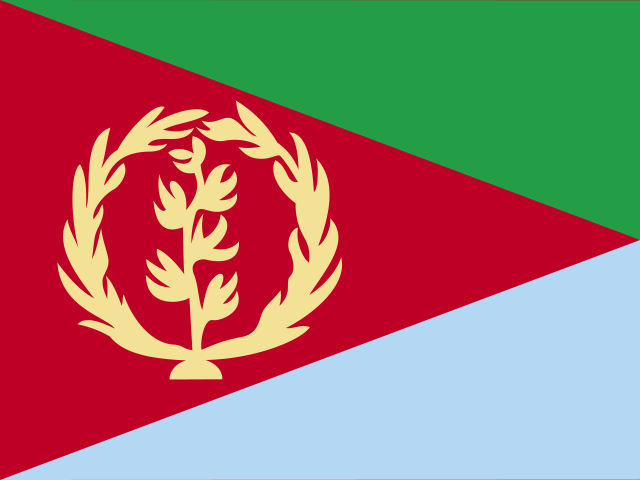
Constitution
The Constitution of Eritrea includes 59 articles addressing, among others, the State's structure, symbols and languages, the National objectives and directive principles, the fundamental rights, freedoms and duties, the institutions in place including the National Assembly, the Executive power, and the judiciary.
This proclamation determines the structure, powers and functions of the Government of Eritrea.
This proclamation provides rules to control drugs, medical supplies and sanitary items.
This law establishes the legal regime for foreign nationals, setting out, in particular, the rules governing their entry, stay and exit from the country, their rights, duties and guarantees. With the exception of visa requirements, this law does not apply to permanent diplomatic and consular agents and their families or to special missions.
The Decree regulates the health care delivery by private entities.
Lei No 21/91 estatuo de refugiado
The law regulates the refugee status. Its definition, the impediment and loss of refugee status, the authorization requirements among others issues.
The law creates the National Health Service of Mozambique. It also provides information on the organization of levels of care in the country: primary, secondary, tertiary and quaternary.