


Directives Nationales sur la Délégation des Tâches en Sante de la Reproduction Planification Familiale Nutrition Maladies non Transmissibles
This document provides National Guidelines on Task Delegation in Reproductive Health Family Planning Nutrition Noncommunicable Diseases.
Décret No 160-218 portant promulgation de la Constitution de la République Centrafricaine
The Constitution of the Central African Republic was adopted in 2016 and promulgated by Decree No 160218. The Constitution consists of 158 Articles that are grouped into 16 titles covering areas such as social foundations and principles, separation of powers within the state, key organs of the state, etc.

Namibia Essential Medicines List
The Namibia Essential Medicines List acts as a guide for the level of availability and use of essential medicines based on the skills levels of health workers as well as the availability of diagnostic facilities at the various levels of the Namibian public sector healthcare system.
National Health Act
This Act provides a framework for a structured uniform health system within Namibia; consolidates the laws relating to state hospitals and state health services, and regulates the conduct of state hospitals and state health services; provides for financial assistance for special medical treatment of State patients; and provides for incidental matters.
Loi No 09.004 Code du Travail de la République Centrafricaine
This Labor Code governs professional relations between Workers and employers resulting from employment contracts concluded to be executed in the territory of the Central African Republic. It determines the procedure for settling individual and collective conflicts resulting from the execution of the employment contract. It also governs the staff of State Companies, Mixed Economy Companies and Public Offices.
Normes relatives au district de santé en République Centrafricaine
This document constitutes a planning tool for health districts to enable them to implement the objectives of equity and improvement in the quality of care planned by the public authorities of the country.
Liste Nationale des médicaments essentiels en République Centrafricaine
This document establishes a National List of Essential Medicines in the Central African Republic.
This Act amends the Medicines and Related Substances Control Act, 2003, so as to amend and delete certain definitions; provides for a period within which the Council must be appointed; provides for the appointment of chairpersons of committees established by the Council; amends provisions relating to the classification of medicines and other substances as scheduled substances; amends provisions relating to the manufacturing, packing and selling of specified Schedule 3 and specified Schedule 4 substances; deletes references to generic substitutions; substitutes references to Schedule 1, Schedule 2, Schedule 3 or Schedule 4 medicines by references to Schedule 1, Schedule 2, Schedule 3 or Schedule 4 substances; inserts provisions relating to the registration of premises engaged in the manufacturing of medicines; amends provisions relating to offences and penalties; amends provisions relating to the destruction of forfeited medicines, scheduled substances or other things; provides for the making of regulations in relation to medicines; amends provisions relating to the exclusion of medicines from the operation of the Act; amends the transitional provisions; amends provisions relating to the repeal and amendment of certain laws; and provides for matters incidental thereto.
Loi No 06.005 du 20 juin 2006 Bangayassi Relative à la Santé de la Reproduction
This law regulates reproductive health in the Central African Republic.
This Proclamation is to protect the present and future generations from the devastating health, social, environmental and economic consequences of tobacco consumption and exposure to tobacco smoke by providing a legal framework for tobacco control measures, and reduce significantly tobacco use and its consequent harm.
Medical and Dental Act
This Act provides for the establishment and constitution of a professional Council for the medical and dental professions; determines the powers, duties and functions of such Council; regulates the registration of medical practitioners and of dentists, and of persons practising certain professions allied to the medical profession or to the dental profession; specifies the education, training and qualifications of persons practising such professions; prohibits the practising of any such profession without being registered; and provides for matters incidental thereto.
Nursing Act
This Act provides for the establishment and constitution of a professional Council for the nursing and midwifery or accoucheury professions; determines the powers, duties and functions of such Council; regulates the registration and enrolment of the members of such professions; specifies the education, training and qualifications of persons practising such professions; prohibits the practising of any such profession without being registered; and provides for matters incidental thereto.
Pharmacy Act
This Act provides for the establishment and constitution of a professional Council for the pharmacy profession; determines the powers, duties and functions of such Council; regulates the registration of pharmacists and persons practising professions allied to the pharmacy profession; specifies the education and training and qualifications of persons practising such professions; prohibits the practising of any such profession without being registered; and provides for matters incidental thereto.
These regulations govern the issuance of work permit to non-nationals.
This Act provides for the establishment of a Namibia Medicines Regulatory Council; for the registration of medicines intended for human and for animal use; for the control of medicines and scheduled substances and provides for incidental matters.
This proclamation govern employment relations between Eritrean employees and foreign diplomatic missions or international organizations operating in Eritrea, unless other specific agreements to the contrary are concluded with Eritrean Government.
Loi No 97-013 portant code de la famille
This law establishes a Family Code.
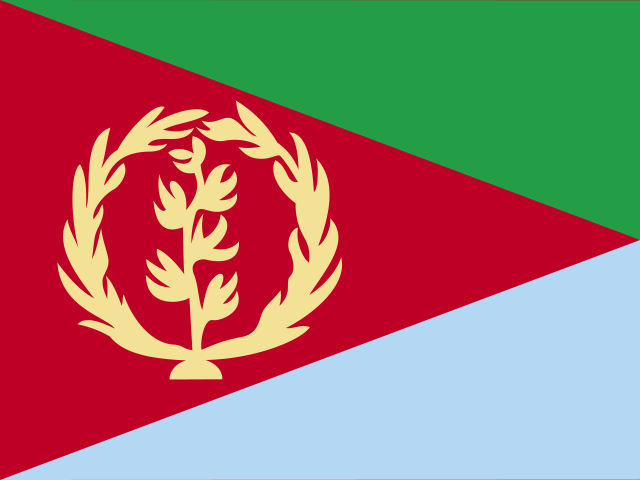
Constitution
The Constitution of Eritrea includes 59 articles addressing, among others, the State's structure, symbols and languages, the National objectives and directive principles, the fundamental rights, freedoms and duties, the institutions in place including the National Assembly, the Executive power, and the judiciary.
Identification Act
This Act provides for the compilation and maintenance of a population register in respect of the population of Namibia, for the issue of identity documents to persons whose names are included in the population register; and for the matters connected therewith.
This proclamation determines the structure, powers and functions of the Government of Eritrea.