

The purpose of this ordinance is to determine the rates and fees for regulatory services offered on drugs and other health products by the drug regulatory authority for Burundi (ABREMA).
The purpose of this ordinance is to organize the registration of medicines for human use and other pharmaceutical inputs in Burundi.
The purpose of this law is to regulate immigration and emigration in Burundi.
The law creates the Burundian Authority for the Regulation of Medicines for Human Use and Food. The authority's general aim is to protect public health by promoting the quality and safety of products such as prefabricated and ambient foods, medicines for human use, cosmetics and dietary products containing active ingredients, herbal medicines, traditional medicines, and medical devices, among others.
The decree provides for the organization and functioning of the Central Purchasing Center for Essential Medicines of Burundi [CAMEBU].
The decree regulates the establishment, organization and functioning of the National Public Health Institute of Burundi.
Directives Nationales sur la Délégation des Tâches en Sante de la Reproduction Planification Familiale Nutrition Maladies non Transmissibles
This document provides National Guidelines on Task Delegation in Reproductive Health Family Planning Nutrition Noncommunicable Diseases.
The law institutes a Social Protection Code in Burundi.
The legislation regulates the production, import, export, conservation, distribution, quality analysis and sale of medicines for human use, including traditional medicines, as well as all other health products, pharmaceutical practice and opticianry.
The Decree defines the normative framework for the organization and operation of the Ministry of Public Health and the fight against AIDS.

Loi No 1/012 du 30 mai 2018 portant Code de l'offre des soins et services de sante au Burundi
The law sets out the fundamental principles and rules for the organization and operation of the national public health system.
Loi No 1/03 du 10 janvier 2018 portant promotion et protection des droits handicapées au Burundi
The aim of the law is to promote and protect the rights of persons with disabilities for their effective integration, so that their dignity is preserved and they can benefit from conditions that enable them, where appropriate, to be useful to themselves, their families, their communities and society as a whole by breaking down barriers of all kinds.

Loi No 2018-027 relative à l’état civil
The purpose of this law is to provide for the rules relating to the civil status of citizens, civil status documents, as well as procedures for registering civil status events and their computerized management. It guarantees every person the enjoyment of the right to recognition in all places of their legal personality.
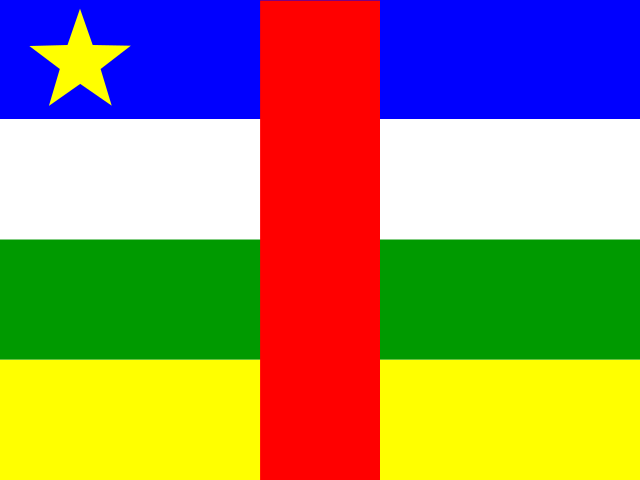
Décret No 160-218 portant promulgation de la Constitution de la République Centrafricaine
The Constitution of the Central African Republic was adopted in 2016 and promulgated by Decree No 160218. The Constitution consists of 158 Articles that are grouped into 16 titles covering areas such as social foundations and principles, separation of powers within the state, key organs of the state, etc.
The purpose of this law is to protect the rights of individuals in the processing of personal data.
Loi No 2011-002 portant Code de la Santé
The Law establishes the Health Code that codifies legislative texts concerning Public Health in Madagascar.
Loi No 2011-003 portant réforme hospitalière
The Law establishes provisions relating to the hospital reform and applies to all hospital establishments in Madagascar.
Loi No 09.004 Code du Travail de la République Centrafricaine
This Labor Code governs professional relations between Workers and employers resulting from employment contracts concluded to be executed in the territory of the Central African Republic. It determines the procedure for settling individual and collective conflicts resulting from the execution of the employment contract. It also governs the staff of State Companies, Mixed Economy Companies and Public Offices.
Normes relatives au district de santé en République Centrafricaine
This document constitutes a planning tool for health districts to enable them to implement the objectives of equity and improvement in the quality of care planned by the public authorities of the country.
Constitution
The Constitution of Madagascar was adopted in 2010. It consists of 168 Articles that are grouped into seven titles. The Constitution addresses a wide range of issues such as the fundamental principles of the State, freedoms, rights and obligations of the citizens, organization of the State, key organs of the state, etc.