

The Constitution of Chad was reviewed and approved by the referendum of the 17 December 2023. The Constitution contains 290 articles addressing a large number of issues as the protection of fundamental rights and freedoms, the fundamental principles of the state and institutional arrangements.
The document establishes the National List of Essential Medicines and Other Health Products.
This decree establishes the terms of organization and operation of the National Health Insurance Fund of Chad.
This law determines the general conditions of asylum in the Republic of Chad in accordance with the Convention relating to the Status of Refugees of July 28, 1951 as amended by its New York Protocol of January 31 and the Convention of the Organization of the African Unity of September 10, 1969 governing aspects specific to refugee problems in Africa.
This law establishes a national health insurance Fund ("Caisse Nationale d'Assurance Santé").
This Act establishes the Pharmacy and Medicines Regulatory Authority; provides for the functions and powers of the Authority; and provides for matters connected therewith and incidental thereto.

Constitution
The Constitution of Chad is the supreme law of the country and outlines the fundamental principles and framework of the government.
This Act makes provision for the prevention and management of HIV and AIDS; provides for the rights and obligations of persons living with HIV or affected by HIV and AIDS; provides for the establishment of the National AIDS Commission; and provides for matters incidental thereto or connected therewith.
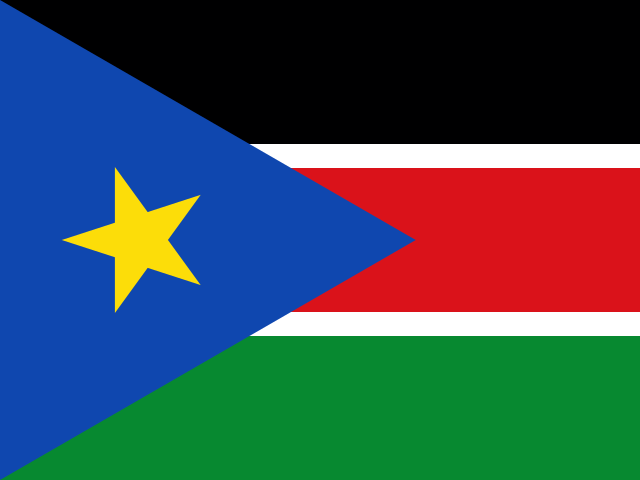
South Sudan Essential Medicines List (SSEML)
The South Sudan Essential Medicines List (SSEML) is a comprehensive list of medications essential for addressing the country's public health needs, prioritizing safe, effective, and affordable treatments for the most common health conditions.
National Health Insurance Fund Act

Gender Equality Act
This Act promotes gender equality, equal integration, influence, empowerment, dignity and opportunities, for men and women in all functions of society, prohibits and provides redress for sex discrimination, harmful practices and sexual harassment, provides for public awareness on the promotion of gender equality, and provides for connected matters.
This Act provides for partnerships between the public sector and private sector for the supply of infrastructure and delivery of services as means of contributing towards sustaining economic growth, social development and infrastructure development; provides for the development and implementation of public-private partnership arrangements in Malawi for the delivery of infrastructure and services; provides for the establishment of the Public Private Partnership Commission; provides for private sector participation in state-owned enterprises, commercial entities and commercial assets, and provides for matters connected with or incidental to the foregoing.
Drug and Food Control Authority Act, No 37
This Act provides for the establishment of an independent Drug and Food Control Authority in South Sudan and provide an appropriate and effective independent regulatory mechanism to control and regulate the manufacture, supply, promotion, marketing, advertising, distribution and use of drugs, poisons, chemicals, cosmetics medical devices and food for human or animal use.
Ordonnance 11-013 2011-02-28 PR portant création de l'Ordre National des Techniciens de la Santé
The Ordinance establishes a National Order of Health Technicians bringing together all health technicians authorized to practice their profession in Chad.
Nationality Regulations
These Regulations outline the rules for acquiring nationality, issuance of the nationality certificates, loss of nationality, civil registry of the South Sudanese nationals, etc.
Constitution
The Constitution of South Sudan was adopted in 2011. It is the supreme law of the state. The Constitution sets out the values and principles of organization of the state, establishes the rights, freedoms and obligations of the people, sets up key state institutions and bodies, etc. The Constitution of South Sudan consists of 200 articles that are grouped into fifteen parts, supplemented by 5 schedules.
This decree creates the services of the decentralized territorial authorities and fixes their attributions.
National Registration Act
This Act provides for the registration of persons and registration of births, marriages and deaths of persons and provides for matters connected therewith and incidental thereto.
This law determines the distribution of powers between the State and decentralized local authorities.
These Guidelines provide comprehensive protocols for healthcare workers in South Sudan, outlining evidence-based practices for preventing and treating common diseases and conditions at primary and secondary care levels.