

The law provides the budget of the state for the year 2023.
The law modifies the law No. 84-10 relative à l’état civil and regulates all the aspects regarding civil status matters.
This Act establishes a National Health Insurance Authority to implement a national health insurance scheme, establishes a national health insurance Fund to pay for the cost of health care services to members of the Scheme, and provides for the establishment of private health insurance schemes.
The Constitution of Comoros was adopted in 2001 and last amended in 2018. The Constitution contains 122 articles addressing a large number of issues as the protection of fundamental rights and freedoms, the fundamental principles of the state and institutional arrangements.
The law establishes the obligation to affiliate to the "Caisse Nationale de Solidarité et de Prévoyance Sociale" for any employer who employs one or more workers, as well as the public administration in its quality of employer.
The Act regulates the quality and safety of medicines and related products and connected matters.

Pharmacy Council Act
This Act promotes and protects the health and safety of the general public through safeguarding, maintaining and enforcing the highest standards in the practice of pharmacy.

Loi No 12-012/AU portant création de la Caisse Nationale de Solidarité et de Prévoyance Sociale
The law creates the "Caisse Nationale de Solidarité et de Prévoyance Sociale" (The National Solidarity and Social Welfare Fund).
Women's Act
The Act implement the legal provisions of the National Policy for the advancement of Gambian Women and Girls, and incorporates and enforces the United Nations Convention on the Elimination of all Forms of Discrimination against Women and the Protocol to the African Charter on Human and Peoples' Rights on the Rights of Women in Africa.
The Act provides for the re-structuring, development, and regulation of the information and communication sectors in The Gambia and for matters connected therewith.
This Act provides for integrated and coordinated disaster management that focuses on prevention, preparedness, response, mitigation, and recovery from, disasters or emergency situations, and the management of their effects, establishes a National Disaster Management Agency and Regional, District and Village Disaster Management Committees.
The Act provides for the establishment of the Royal Victoria Teaching Hospital and its Management Board, and for connected matters.
Children's Act
This Act sets out the rights and responsibilities of children, consolidates the laws relating to children, provides for the care, protection and maintenance of children, establishes a Children’s Court, provides for a criminal justice system for children and other connected purposes.
Statistics Act
This Act provides for a sustainable, effective and efficient national statistical system for The Gambia for the collection, production and dissemination of integrated, relevant, reliable, timely statistical information, establishes The Gambia Bureau of Statistics as a supervisory authority for the national statistical system.
This Proclamation is to protect the present and future generations from the devastating health, social, environmental and economic consequences of tobacco consumption and exposure to tobacco smoke by providing a legal framework for tobacco control measures, and reduce significantly tobacco use and its consequent harm.
These regulations govern the issuance of work permit to non-nationals.
The Local Government Act
The Act establishes and regulates a decentralised local government system for the Gambia; it makes provision for the functions, powers and duties of local authorities and for matters connected therewith.
This proclamation govern employment relations between Eritrean employees and foreign diplomatic missions or international organizations operating in Eritrea, unless other specific agreements to the contrary are concluded with Eritrean Government.
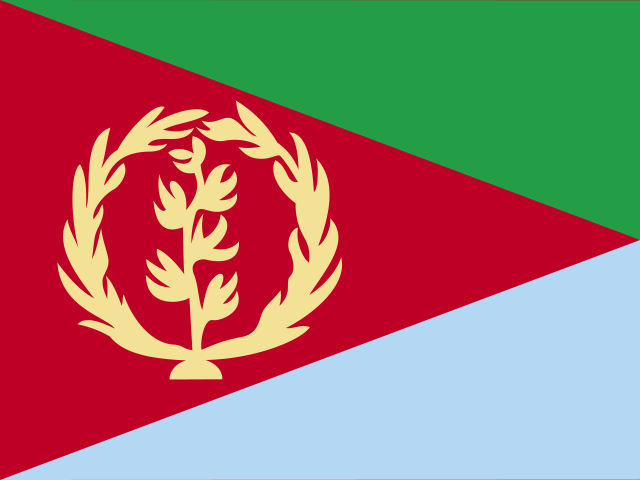
Constitution
The Constitution of Eritrea includes 59 articles addressing, among others, the State's structure, symbols and languages, the National objectives and directive principles, the fundamental rights, freedoms and duties, the institutions in place including the National Assembly, the Executive power, and the judiciary.
Constitution
The Constitution of the Gambia was adopted in 1997. It is the supreme law of the country and consists of 232 articles that are grouped into 23 chapters. The Constitution sets out the values and principles of the state, defines supremacy rules for the law, proclaims fundamental rights and freedoms, establishes key bodies of the state, etc.