

This decree modifies decree N°2016-598 providing for the organization of the Ministry of Health and Public Hygiene. Changes relate to the creation of a new directorate for judicial affairs and litigation ("direction des affaires juridiques et du contentieux") under the Cabinet and the creation of a Directorate for Family, Mother and Children's health under the General Directorate for Health and Public Hygiene.

This Decree regulates the organization, structure and mandate of the Ministry of Health of Gabon.

The law modifies the articles 8, 135,137,139,159,160,166,195,204,226,244,250,275,292 and the title XII of the Constitution of the Republic of Mozambique.

Public health Act
This Act provides for public health, the conditions for improvement of the health and quality of life and the health care for all people in Zimbabwe, the rights, duties, powers and functions of all parties in the public health system, and the measures for administration of public health.
The resolution approves the Organic Statute of the Ministry of Health. It defines aspects as it competencies, functions, and the functions of it organs among other aspects.
This Order creates and sets the rules for the organization and operation of the Health Economics Unit under the Ministry of Health and Social Action of Senegal.
The decree governs the organization of the Ministry of Health.

Constitution
The Constitution was promulgated by the Law N° 2016-886 of 8 November 2016 and modified by constitutional law N° 2020-348 of 19 March 2020. It includes 184 articles addressing a wide array of issues including among other things fundamental freedoms, duties and rights, the fundamental principles of the Republic and institutional arrangements.

The short title of this Act is the Health Ministry Act. This Act amends the 1972 Act establishing the Ministry of Health and Social Welfare to create and establish the Ministry of Health.
Constitution
The Constitution includes 246 articles addressing among other, the State and Sovereignty, Fundamental Rights and Freedoms, institutions in place (e.g., executive power, legislative power, and judicial power ) as well as established councils such as the Economic, social and environmental council, the superior council of the freedom of communication or the national consultative councils (non-exhaustive list).

The executive Decree No 13-155 of 4 Joumada Ethania 1434 amends the Executive Decree No 96-68 of 7 Ramadhan 1416 corresponding to 27 January 1996 on the creation, missions, organization and operation of the Inspectorate-General of the Ministry of Health and Population. This decree was published in the Official Journal of 25 April 2013 (page 27).

This decree governs the organisation of the Ministry of Public Health and addresses among other things, the missions of the ministry (art. 1) and its structure (general structure is fleshed out under article 2).
Constitution
This Act repeals and substitutes the Constitution of Zimbabwe. The new Constitution, provided in the schedule of the Act, includes 345 articles addressing a wide array of issues including, among others, founding provisions, national objectives, citizenship, declaration of rights, the executive, the legislature, the judiciary and the courts, principles of public administration, civil service and security services, local authorities, corruption etc. (non-exhaustive list).
The decree N°11-380 provides for the organization of the central administration of the ministry of Health, Population and Hospital Reform. The text of the decree has been published in the official journal of 23 November 2011 (pages 5-6).
Constitution
The Constitution of South Sudan was adopted in 2011. It is the supreme law of the state. The Constitution sets out the values and principles of organization of the state, establishes the rights, freedoms and obligations of the people, sets up key state institutions and bodies, etc. The Constitution of South Sudan consists of 200 articles that are grouped into fifteen parts, supplemented by 5 schedules.

The Constitutional Petition No. 16 of 2011 challenges the government's failure to provide minimum maternal health services, asserting that this violates constitutional rights to health, life, and dignity. In 2015, the Constitutional Court ruled in favor of the petitioners, emphasizing the need for the government to ensure access to essential maternal health services, such as skilled birth attendants and emergency obstetric care, to protect the right to life and dignity.

The Constitution of Angola was promulgated in 2010. The Constitution contains 244 articles addressing a large number of issues such as the protection of fundamental rights, freedoms, guarantees and duties, the fundamental principles of the state and institutional arrangements. The Constitution was amended in 2021 (the 2021 amendment is available in the legislation repository).
Constitution
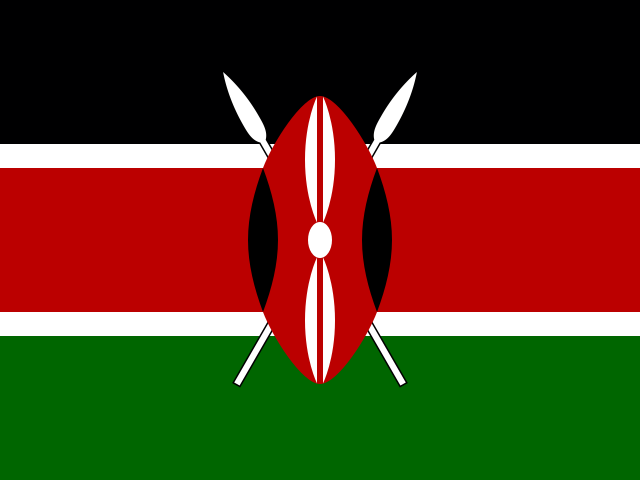
The Constitution of Kenya is a supreme law of the Republic of Kenya. It was adopted in 2010 and replaced the previous Constitution of 1963. The Constitution consists of 264 articles that are arranged into 18 chapters covering such issues as the bill of rights, organization of the state, separation of powers, electoral framework, etc.

Constitution
The Constitution of Madagascar was adopted in 2010. It consists of 168 Articles that are grouped into seven titles. The Constitution addresses a wide range of issues such as the fundamental principles of the State, freedoms, rights and obligations of the citizens, organization of the State, key organs of the state, etc.

The Constitution was promulgated by Decree No 2010-754 of 25 November 2010. It includes 185 articles addressing a wide array of issues including, among other things, human rights and duties and institutional arrangements.