


The purpose of this law is to combat the spread of the disease caused by the Human Immunodeficiency Virus (HIV) leading to the reduction and loss of the body's immune defenses, resulting in Acquired Immunodeficiency Syndrome (AIDS); to protect people living with HIV/AIDS against all forms of discrimination or stigmatization; and to reaffirm their fundamental rights and freedoms in accordance with international human rights instruments.

The Constitution was promulgated in 2005 and reviewed in 2018. The Constitution contains 292 articles addressing a broad range of issues as the protection of fundamental rights and freedoms, the fundamental principles of the state and institutional arrangements.

Ley No 3/2005 sobre la prevención y la lucha contra las infecciones de transmisión sexual VIH/Sida y la defensa de los derechos humanos de las personas afectadas
The purpose of this Law is to create a legal framework that allows for the implementation of the actions and mechanisms necessary for the education, prevention, treatment, epidemiological surveillance, research, care and monitoring of sexually transmitted infections and HIV/AIDS, as well as to guarantee respect, protection and defence of human rights, and to eliminate the stigmatization and discrimination of people infected with HIV/AIDS. This law can be located on page 24 of the file.

Constitution
The Constitution includes 279 articles addressing a wide array of issues including the Kingdom and its constitution, the protection and promotion of fundamental rights and freedoms, the acquisition and loss of citizenship, the directive principles of state policy, as well as institutional arrangements (the executive, the legislature, the judicature, local governments, and traditional institutions). The Constitution also addresses public services, public finance, and international relations. (non-exhaustive list).
This Regulation establishes the legal framework applicable to the contracting of public works, and the supply of goods and services to the State, including consultancy and concessions.

Constituição
The Constitution was promulgated in 2004 and modified in 2018. It includes 306 articles (17 titles) addressing a large number of issues as the protection of fundamental rights and freedoms, the fundamental principles of the state and institutional arrangements.
Standards and Quality Act, 2003
The Act establishes the Swaziland Standards Authority and provides for matters connected thereto.

Constitution
The Constitution of Rwanda was promulgated in 2003 and reviewed in 2015. The Constitution contains 177 articles addressing a large number of issues as the protection of fundamental rights and freedoms, fundamental principles of the state and institutional arrangements.

Constituição
The Constitution of Sao Tome and Principe was promulgated by a Law No 1/2003. The Constitution of Sao Tome and Principe is the supreme law of the state that sets out the key values and principles of organization of the state, establishes rights, freedoms and obligations of the people, sets up the key bodies and institutes of the state, provides for the division of the powers within the country, etc. The Constitution of Sao Tome and Principe consists of 160 articles that are grouped into 5 parts.

The Local Government Act
The Act establishes and regulates a decentralised local government system for the Gambia; it makes provision for the functions, powers and duties of local authorities and for matters connected therewith.
Décreto No 78/2001 por el que se aprueban el Plan Marco Estratégico y el Plan de urgencia de Lucha contra el SIDA en Guinea Equatorial
This Decree approves the Strategic Framework Plan and the Emergency Plan for the Fight against AIDS in Equatorial Guinea. This document is published as a part of a compilation of laws and decrees and this Decree is located on page 81 of the file.
This Ministerial Diploma approves the norms of the organization of the National Health Service for the care and treatment of people living with HIV/AIDS and the Guiding Principles for the treatment of patients with HIV/AIDS Infection and the respective Technical Guides.

Constitution
The Constitution of Senegal was adopted 2001 and promulgated by law No 2001-03 of 22 January 2001. The Constitution consists of 103 articles that are grouped into 12 titles. The Constitution establishes key principles and values of the state, provides for the separation of powers, establishes the rights and freedoms of the people, sets up the key state organs and their mandates, etc.

Local Government Act
This Act amends and consolidates the law relating to local government and provides for the matters connected therewith and incidental thereto.

The Constitution of Nigeria was promulgated in 1999 and reviewed in 2023. The Constitution contains 320 articles addressing a large number of issues as the protection of fundamental rights and freedoms, the fundamental principles of the state and institutional arrangements (see more below).
Constitution
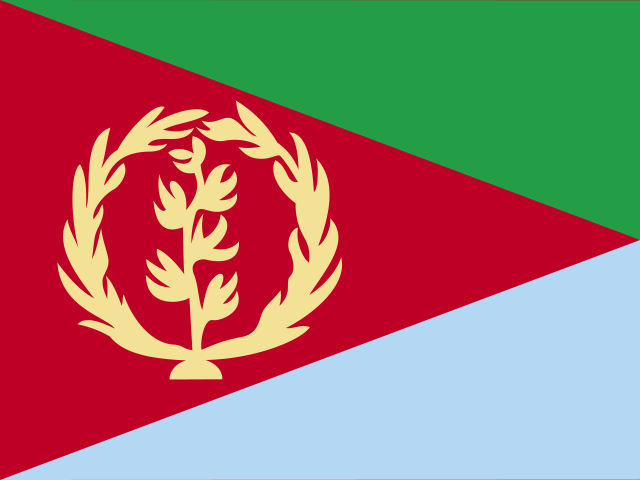
The Constitution of Eritrea includes 59 articles addressing, among others, the State's structure, symbols and languages, the National objectives and directive principles, the fundamental rights, freedoms and duties, the institutions in place including the National Assembly, the Executive power, and the judiciary.
Constitution
The Constitution of the Gambia was adopted in 1997. It is the supreme law of the country and consists of 232 articles that are grouped into 23 chapters. The Constitution sets out the values and principles of the state, defines supremacy rules for the law, proclaims fundamental rights and freedoms, establishes key bodies of the state, etc.
Constitution
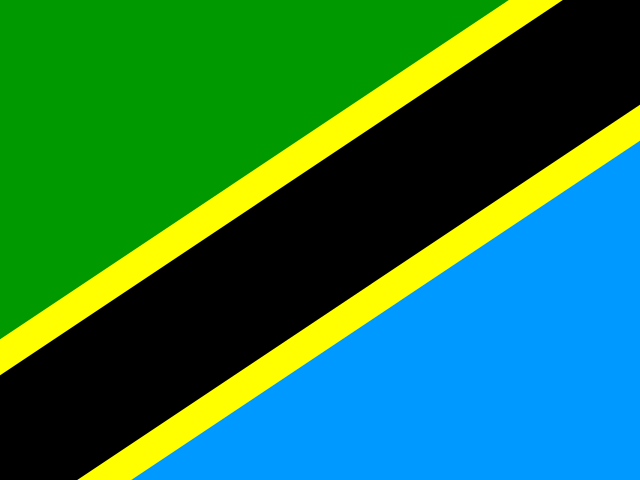
The Constitution of the United Republic of Tanzania was adopted in 1977 and amended in 2005. The Constitution is the supreme law of the country and establishes the state principles, regulates the separation of powers, establishes key government structures and their mandates, establishes rights, etc. The Constitution consists of 152 articles that are organized into ten chapters that are supplemented by two schedules.

The decree N°96-68 addresses the creation, missions, organization and operation of the Inspectorate-General of the Ministry of Health and Population. The text of the decree is provided as part of a compendium of health-related legislation (see pages 22-.24).

Income Tax Act
This Act governs the taxation of individuals, companies and other entities in Mauritius and outlines rules for income tax, tax rates, deductions, exemptions and the administration of tax collection, etc.