


Procurement Act, 2011
The Act provides for the regulation and control of practices in respect of public procurement.
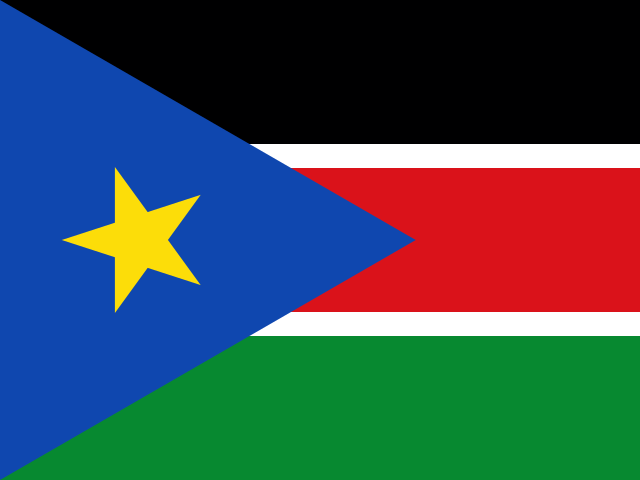
Constitution
The Constitution of South Sudan was adopted in 2011. It is the supreme law of the state. The Constitution sets out the values and principles of organization of the state, establishes the rights, freedoms and obligations of the people, sets up key state institutions and bodies, etc. The Constitution of South Sudan consists of 200 articles that are grouped into fifteen parts, supplemented by 5 schedules.

The Constitutional Petition No. 16 of 2011 challenges the government's failure to provide minimum maternal health services, asserting that this violates constitutional rights to health, life, and dignity. In 2015, the Constitutional Court ruled in favor of the petitioners, emphasizing the need for the government to ensure access to essential maternal health services, such as skilled birth attendants and emergency obstetric care, to protect the right to life and dignity.

The Constitution of Angola was promulgated in 2010. The Constitution contains 244 articles addressing a large number of issues such as the protection of fundamental rights, freedoms, guarantees and duties, the fundamental principles of the state and institutional arrangements. The Constitution was amended in 2021 (the 2021 amendment is available in the legislation repository).
The Decree establishes the system for financing the actions of provincial governments and municipal administrations, as deconcentrated executive bodies of the central administration, within the framework of the delimitation of competences for the provision of public goods and services between the central administration and local administrations and between them.
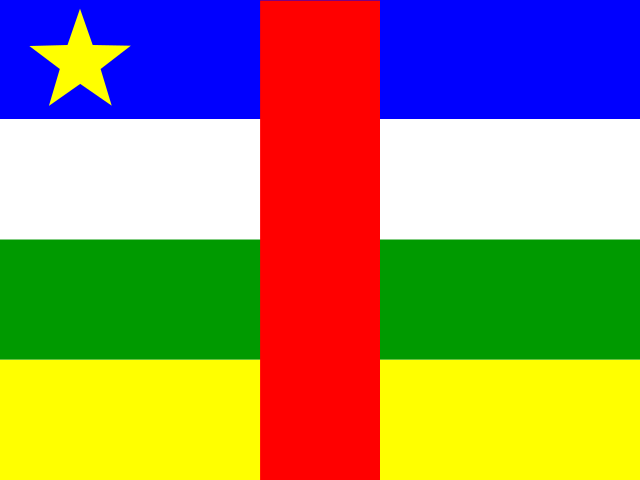
Normes relatives au district de santé en République Centrafricaine
This document constitutes a planning tool for health districts to enable them to implement the objectives of equity and improvement in the quality of care planned by the public authorities of the country.

This decree creates the services of the decentralized territorial authorities and fixes their attributions.

The Law establishes a mandatory health insurance scheme for pensioners, employees and members of their families in Ethiopia.
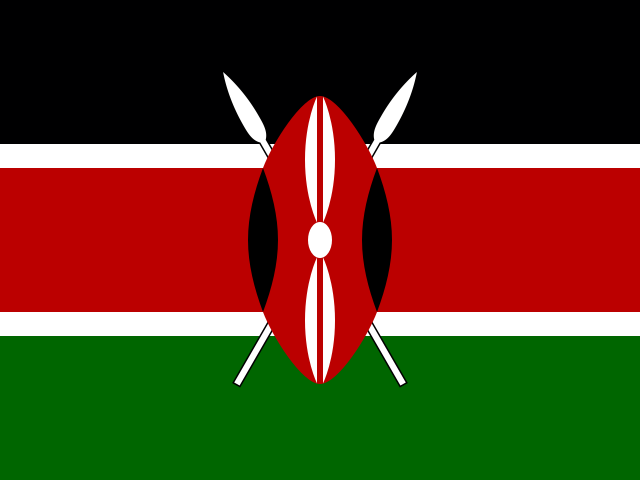
Constitution
The Constitution of Kenya is a supreme law of the Republic of Kenya. It was adopted in 2010 and replaced the previous Constitution of 1963. The Constitution consists of 264 articles that are arranged into 18 chapters covering such issues as the bill of rights, organization of the state, separation of powers, electoral framework, etc.

Constitution
The Constitution of Madagascar was adopted in 2010. It consists of 168 Articles that are grouped into seven titles. The Constitution addresses a wide range of issues such as the fundamental principles of the State, freedoms, rights and obligations of the citizens, organization of the State, key organs of the state, etc.
The Constitution was promulgated by Decree No 2010-754 of 25 November 2010. It includes 185 articles addressing a wide array of issues including, among other things, human rights and duties and institutional arrangements.
This ordinance establishes a General Code of Local Authorities in the Republic of Niger. The General Code of Local Authorities sets out the fundamental principles of the free administration of local authorities, their powers and their resources. It establishes the legal framework for their management.

Constitution
The Constitution of Niger (2010) is structured into several titles, each addressing different aspects of the state's governance and the rights of its citizens. The document begins with a Preamble, followed by Title I: The State and Sovereignty, which outlines the fundamental principles of the Republic of Niger. Title II: Rights and Duties of the Human Person includes various articles on individual rights, including health rights. Title III: Executive Power details the roles and responsibilities of the President and the Government. Title IV: Legislative Power focuses on the functions of the National Assembly. Title V: Relations Between Executive and Legislative Powers describes the interaction between these branches. Title VI: Judicial Power covers the judiciary's independence and structure. Title VII: Economic, Social, and Cultural Development outlines the state's development policies. Title VIII: The Higher Council of Communication addresses media and communication regulations. Title IX: Local Authorities discusses decentralization and local governance. Title X: Treaties and International Agreements covers the process of treaty ratification. Title XI: Cooperation and Association with States focuses on international cooperation. Title XII: Revision details the process for amending the Constitution. Title XIII: Transitional Provisions and Title XIV: Final Provisions conclude the document. Articles 12 and 13 specifically refer to health rights. Article 12 states that everyone has the right to health, and Article 13 emphasizes the state's duty to create conditions ensuring access to medical services and assistance in case of illness.
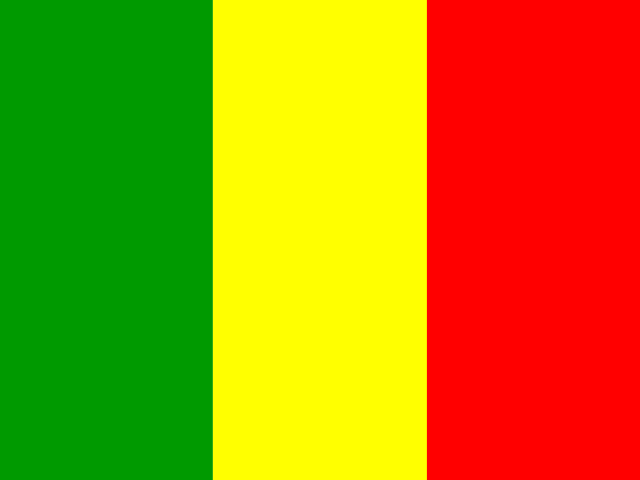
The law institutes the Compulsory Health Insurance scheme in Mali. Its purpose is to cover the health care costs inherent in sickness and maternity for insured persons and their dependent family members. The law defines the beneficiaries, the guaranteed benefits, the conditions of coverage, affiliation and registration, and financial organization, among other aspects.
The law regulates the compulsory health insurance scheme, the terms and conditions of membership, the benefits covered, the assumption of responsibility for benefits and care providers among other areas.

This decree, taken in application of the provisions of article 62 of order No. 0022/PR/2007 of August 21, 2007, defines the basket of care of the Compulsory Health Insurance and Social Security Scheme.
This decree, taken in application of the provisions of Articles 28 et seq. of Ordinance No. 0022/PR/2007, 6 et seq. of Ordinance No. 0023/PR/2007 and 3 et seq. of Law No. 11/82 of 24 January 1983, establishes the statutes of the National Health Insurance and Social Guarantee Fund, abbreviated to CNAMGS, hereinafter referred to as "the Fund".
This decree, taken in application of the provisions of articles 51 of the Constitution and 107 of Ordinance No. 0022/PR/2007 of August 21, 2007, establishes the technical operating procedures of the Compulsory Health Insurance and Social Security Scheme.
This order, taken in application of the provisions of Law No 013/2007 of July 19, 2007, establishes a compulsory health insurance and social security system in the Gabonese Republic.

Lei No 4/2007 Lei de enquadramento da protecção social
The law regulates social protection in Guinea-Bissau, including funding systems.