


The law modifies the law No. 84-10 relative à l’état civil and regulates all the aspects regarding civil status matters.

The Proclamation establishes an Ethiopian Identity System applicable to any person residing in Ethiopia.

This law, adopted in application of the provisions of Articles 1 and 47 of the Constitution, relates to the protection of personal data.

Décret No 22/ 07 portant création d'un fichier général de la population en République Démocratique du Congo
This Decree establishes a general population registry in the Democratic Republic of the Congo.

Data Protection Act, 2022
The Act provides for the collection, processing, disclosure, and protection of personal data.
This decree, taken in application of the provisions of articles 22, 29 and 30 of Law No. 20/2005 of January 3, 2006, provides for the creation, attributions, organization and operation of the Public Health Emergency Operations Center in the Gabonese Republic, abbreviated to COUSP.
The Act amended the National Identity Cards Act, 2011.

The Rwanda Hospital Accreditation Standards Performance Assessment Tool has been developed based on the 2nd edition of the hospital standards to assist supervisors, facility managers and staff in assessing the quality of their services. The toolkit can be used to guide the set-up of services and to improve current services. It helps to measure progress towards meeting standards and will be used by external surveyors to accredit facilities.
The document sets accreditation standards for Hospitals in Rwanda. They are designed for use within the entire organization and cover the full range of services.
The standards define the minimum requirements that must be covered by Level Two teaching Hospitals for undergraduate and postgraduate training programs and they will be used as an inspection checklist for accreditation.

Loi n° 001-2021/AN portant protection des personnes à l'égard du traitement des données à caractère personnel
The purpose of the law is to protect the fundamental rights and freedoms of individuals with regard to the processing of their personal data, whatever the nature, method of execution or persons responsible. This law applies to the processing of personal data contained or intended to be contained in a file, whether wholly or partly automated, as well as to non-automated processing of personal data. In particular, it applies to the processing of personal data relating to electronic communications.

The law makes the second amendment to the general legal regime for the protection of personal data of natural persons approved by Law no. 133/V/2001, of January 22, as amended by Law no. 41/VIII/2013, of September 17.

The law authorized the extension of the state of health emergency in 2021.
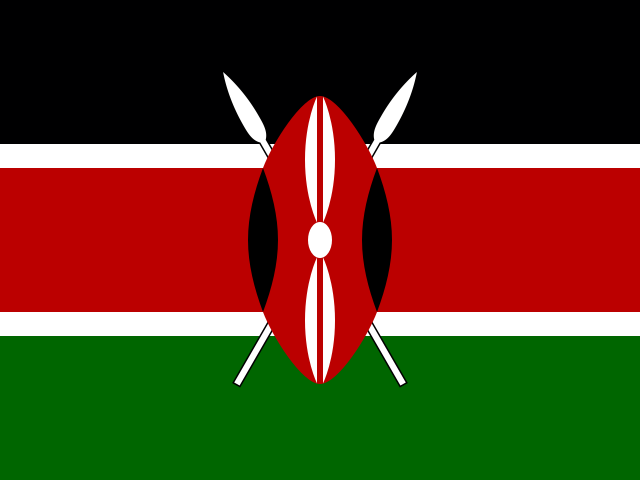
The Kenya National Framework for the Organization of Trauma Services is the first-ever guidance in Kenya to establish a working Trauma Care System as a key component of the healthcare system. The framework highlights the key components required to provide quality continuum of care, which includes injury prevention, pre-hospital care, hospital, and rehabilitation care.
The Kenya Public Health Emergency Operations Center (KPHEOC) Standard Operating Procedures (SOPs) are part of the Ministry of Health Preparedness System. This SOP describes the procedures for activating, operating, and deactivating the KPHEOC.
The Kenya Public Health Emergency Supply Chain Framework provides guidance regarding preparedness and response for emergency operations in the country. The Emergency Supply Chain Framework was developed to enable the Public Health Emergency Operations Centre efficiently deploy medical countermeasures (MCMs) during emergencies.

Public health (Covid 19) (Risk determination and Mitigation measures) (N°5) Regulations, 2021
The document has the regulation taken by Lesotho’s government during the emergency of COVID 19.
The Law aims at the protection of personal data and privacy and determines their processing.

The law amends articles of law No. 2020-009 of September 10, 2020 relating to the biometric identification of individuals in Togo.

Data protection Act
This Act provides for data protection measures, and among other things, establishes a Data Protection Authority, provides for their functions, creates a technology-driven business environment and encourages technological development and the lawful use of technology and provides for investigation and collection of evidence of cybercrime and unauthorised data collection and breaches.