

The decree defines the health benefit package of the universal health insurance scheme.
The objective of this law is to provide the rules relating to public hygiene and sanitation in rural and urban areas.
These regulations were developed in the exercise of the powers conferred by sections 24, 30, 46)2), 47(5) and 50(1) of the Social Health Insurance Act, 2023, by the Cabinet Secretary for Health, in consultation with the Board for the Social Health Authority.
The Decree establishes the health benefit package covered under the Universal Health Insurance. The decree was published on 25 November 2023 in the Official Journal.

The law adopts the Code of Administrative Procedure. The Code establishes the principles and rules to be observed in the exercise of administrative activity, aimed at achieving the public interest, while respecting the subjective rights and legally protected interests of individuals and legal persons.
The Decree specifies the application of certain provisions of the law establishing the Universal Health Insurance Scheme, such as affiliation and registration, the insured person's card, care benefits covered, the assumption of responsibility for benefits, health care providers, among other aspects.

The law determines the essential rules relating to public health and hygiene in the Republic of Niger. The law contains articles referring to the fundamental principles of health in Niger, such as the functioning of the national health system, or health information; as well as the fundamental principles of hygiene, such as urban health and food safety.

This document provides the benefits package of the National Health Insurance Scheme as offered to its beneficiaries through private health providers.

These Instructions establish the methodology to determine the community-based health insurance benefit package.
This law establishes a universal health insurance in the Togolese Republic.
The Civil Code is a document that brings together rules relating to civil law, governing topics such as the status of persons, property, as well as private relations between citizens.

Loi ordinaire 2019/0059/AN du 30 septembre 2019 portant code de l'enfant de la Republique de Guinee
The code aims to promote and guarantee children's access to the enjoyment and exercise of their rights.

This Law establishes the Universal Health Insurance Scheme Universal (RAMU) in the Republic of Benin.
This Ministerial Order determines the medical services provided at each level of health facilities in Rwanda.

Loi N°2015-532 portant Code du travail
This law provides for the Labour Code, establishing the rules governing the relations between employers and (salaried) employees in the country.

This Order determines the list of serious or disabling illnesses for which the insured person is entitled to total or partial exemption from payment of the portion of the costs remaining his responsibility, as well as the conditions under which the exemption is granted.

The Proclamation establishes a mandatory health insurance scheme for pensioners, employees and members of their families in Ethiopia.
This Decree defines the attributions, the organization and the functioning of the Public Hygiene Police of Mauritania.
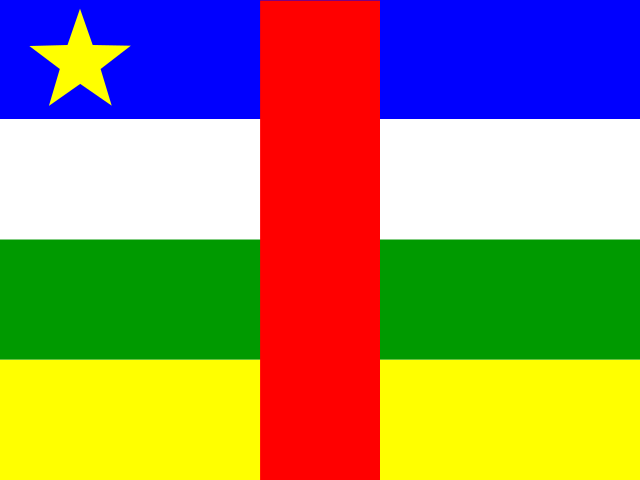
Loi No 09.004 Code du Travail de la République Centrafricaine
This Labor Code governs professional relations between Workers and employers resulting from employment contracts concluded to be executed in the territory of the Central African Republic. It determines the procedure for settling individual and collective conflicts resulting from the execution of the employment contract. It also governs the staff of State Companies, Mixed Economy Companies and Public Offices.
This Law defines the rules of public health and hygiene in the Islamic Republic of Mauritania, in particular on public spaces, homes, food and non-food products, water, commercial facilities and industries, educational and health establishments, public buildings, and the natural environment. Its main objective is to preserve and promote public health.