

Image
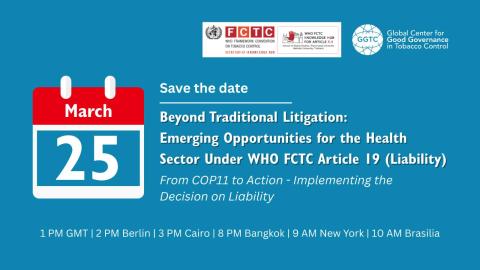
Organizers: Global Center for Good Governance in Tobacco Control (GGTC), WHO FCTC Knowledge Hub for Article 5.3
Date: Wednesday, 25 March 2026
Time: 13:00 GMT | 14:00 Berlin | 15:00 Cairo | 20:00 Bangkok | 10:00 Brasilia | 09:00 New York
Background
This webinar, in coordination with the WHO TFI Programme – WHO Regional Office for the Eastern Mediterranean Region (EMRO), provides the first structured global dissemination of the decision adopted at the Eleventh session of the Conference of the Parties (COP11) to the WHO Framework Convention on Tobacco Control (WHO FCTC) on Article 19 (Liability).
Article 19 provides for criminal, civil, and administrative liability. While attention has historically focused on litigation, discussions at the tenth and eleventh sessions of the Conference of the Parties (COP10 and COP11) emphasized a broader understanding of liability, including administrative enforcement, effective, proportionate, and dissuasive sanctions, cost allocation tools, and safeguards against liability evasion.
COP10 initiated formal exploration of these pathways, and COP11 invited Parties to consider strengthening administrative and other non-judicial measures, including policy options and tools for cost-recovery mechanisms.
The webinar will focus on practical regulatory strengthening and country practices, including improving sanction deterrence, using administrative tools to accelerate enforcement, exploring cost allocation mechanisms, reducing vulnerability to regulatory capture, and identifying measures feasible in low- and middle-income contexts. Administrative liability complements litigation and may be more immediately accessible.
Objectives
By the end of this webinar, participants should:
Target Audience
Primary:
Secondary:
Tentative Program
# | Segment Title | Focus | Speaker | Time |
1 | Introduction |
| Chair Judith Mackay | 3 min |
2 | Opening Remarks | The Value of the Decision on WHO FCTC Art 19 Liability at COP11 | Reina Roa (TBC) | 3 min |
3 | From EMR Conceptual Leadership to COP11 Outcome | How EMR advanced administrative liability framework; Walkthrough of COP11 operative language on administrative and non-judicial liability | Jawad Al-lawati | 6 min |
4 | Administrative Liability Architecture Under Article 19 | Based on Towards Health with Justice; sanction calibration; deterrence logic; cost allocation principles; feasibility in LMICs | Deborah Sy | 8 min |
5 | COP11 in Context: The “Beyond the Courts” Moment including Tools | Counterpoint from BMJ blog: How COP11 Decision can help Determine What Can Be Done Beyond the Courts to Advance Article 19 inc Tools referenced in Expert Group report (Annex 1) and Gaps | Raouf Alebshehy | 6 min |
6 | Administrative Enforcement in Practice: What GTI Findings Reveal | GTI findings on Enforcement & CSR (ie how low penalties create economically rational non-compliance; how CSR is rampant but tokenistic; why sanctions must be effective and dissuasive and opportunities for fees and surcharges) | Mary Assunta | 8 min |
7 | Practical Example 1: Canada’s Cost-Recovery Model | Spotlight Canada: How annual cost-recovery fee operates | Rob Cunningham | 6 min |
| Practical Example 2: Environmental and Human Rights Tribunals
| Spotlight: Tobacco in Environmental and Human Rights Tribunals | Daniel Dorado | 6 min |
8 | Moderated Regional Reflections on What Can be Done to Implement the COP11 Decision | Regional and Country Spotlight: Short interventions on feasibility, enforcement gaps, and political constraints (Singapore: Administrative Fines; India: Tobacco in Environmental Tribunals; France: Civil Society Support) | Leimapokpam Swasticharan (TBC)
Emma Beguinot
Moderated by the Chair | 18 min |

