

Image
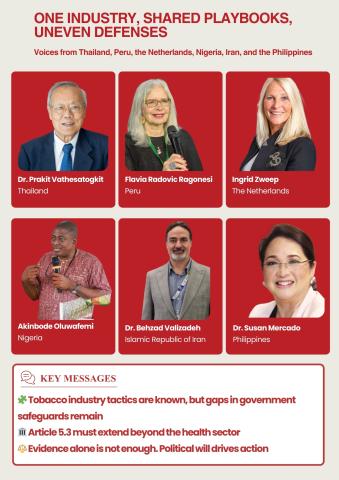
This synthesis draws on six interviews with tobacco control advocates across regions. A consistent conclusion emerges: tobacco industry interference follows a similar strategic logic across contexts, but its impact depends on governance structures and institutional strength. The key variation lies in how governments respond and where safeguards are weakest.
Across contexts, familiar tactics persist, including cross-sector lobbying, economic narratives, and the promotion of newer tobacco and nicotine products. These tactics are often adapted to local political and economic conditions, but remain consistent in their underlying approach.
A central finding is that Article 5.3 is weakest when confined to the health sector rather than applied across government. Where it is embedded in law or binding rules, implementation is more consistent; where it relies on voluntary guidance, it is more easily bypassed.
Conflicts of interest further shape outcomes, particularly where states are economically linked to tobacco. Parliament also remains a key entry point for industry influence, and without explicit safeguards, implementation remains incomplete.
Civil society plays a vital role, but protection varies widely. Where civil society bears primary responsibility for enforcement, implementation is inherently fragile.
Overall, Article 5.3 is widely recognized but unevenly operationalized, and the challenge is one of governance, not awareness. Strengthening implementation requires binding whole-of-government measures, parliamentary accountability, and protection of advocates. Without these, Article 5.3 risks remaining a shared aspiration rather than a shared standard.
To read the full interview, click here.

