


Loi No 2011-003 portant réforme hospitalière
The Law establishes provisions relating to the hospital reform and applies to all hospital establishments in Madagascar.

Clinical Trials Act
This Act regulates the conduct of clinical trials for medicinal products in Mauritius.
The law sets the rules applicable to legal aid and judicial assistance and creates the National Agency for Legal Aid and Judicial Assistance, which is responsible for implementing the provisions relating to legal aid and judicial assistance.
The law creates a public administrative establishment, with legal personality and financial autonomy, called the Centre national de lutte contre le cancer (National Cancer Center).
Constitution
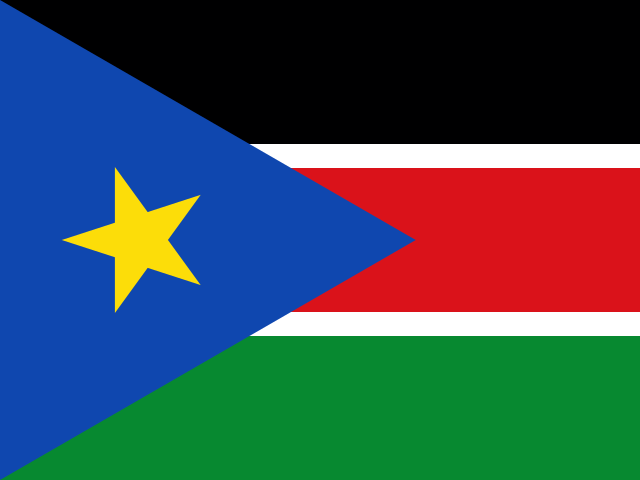
The Constitution of South Sudan was adopted in 2011. It is the supreme law of the state. The Constitution sets out the values and principles of organization of the state, establishes the rights, freedoms and obligations of the people, sets up key state institutions and bodies, etc. The Constitution of South Sudan consists of 200 articles that are grouped into fifteen parts, supplemented by 5 schedules.

The Constitution of Angola was promulgated in 2010. The Constitution contains 244 articles addressing a large number of issues such as the protection of fundamental rights, freedoms, guarantees and duties, the fundamental principles of the state and institutional arrangements. The Constitution was amended in 2021 (the 2021 amendment is available in the legislation repository).
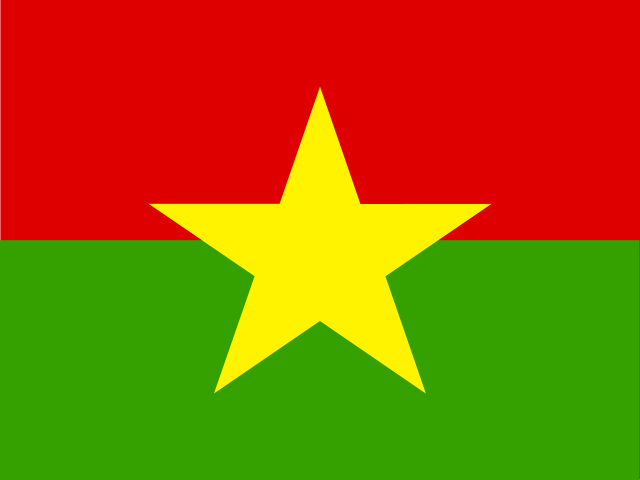
The law reinforces the fight against the use and consumption of tobacco and tobacco products in Burkina Faso. The scope of the law covers the industrial or supervised cultivation of tobacco, the manufacture, packaging, marketing and consumption of tobacco and tobacco products, and exposure to tobacco smoke.

The Law establishes a mandatory health insurance scheme for pensioners, employees and members of their families in Ethiopia.

Women's Act
The Act implement the legal provisions of the National Policy for the advancement of Gambian Women and Girls, and incorporates and enforces the United Nations Convention on the Elimination of all Forms of Discrimination against Women and the Protocol to the African Charter on Human and Peoples' Rights on the Rights of Women in Africa.

The law establishes the conditions for the attribution, acquisition, loss and reacquisition of nationality.
Constitution
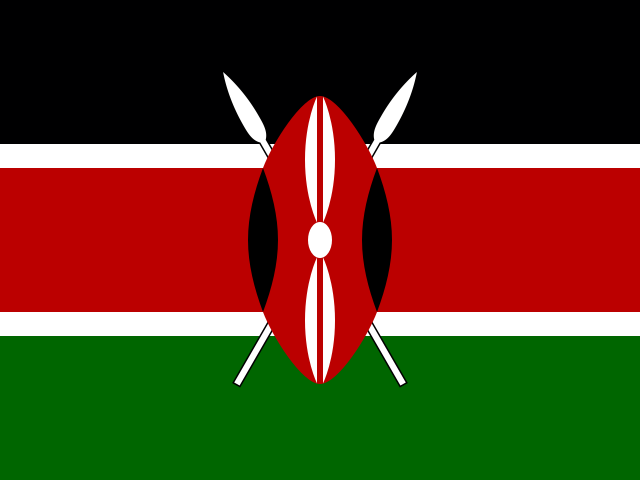
The Constitution of Kenya is a supreme law of the Republic of Kenya. It was adopted in 2010 and replaced the previous Constitution of 1963. The Constitution consists of 264 articles that are arranged into 18 chapters covering such issues as the bill of rights, organization of the state, separation of powers, electoral framework, etc.
Constitution
The Constitution of Madagascar was adopted in 2010. It consists of 168 Articles that are grouped into seven titles. The Constitution addresses a wide range of issues such as the fundamental principles of the State, freedoms, rights and obligations of the citizens, organization of the State, key organs of the state, etc.

This Law defines the legal provisions relating to medicines, medical devices, other health products and the practice of pharmacy in the Islamic Republic of Mauritania. This Law is published in a collection of other legislative acts and can be found on page 3 of the file.
The Constitution was promulgated by Decree No 2010-754 of 25 November 2010. It includes 185 articles addressing a wide array of issues including, among other things, human rights and duties and institutional arrangements.

Constitution
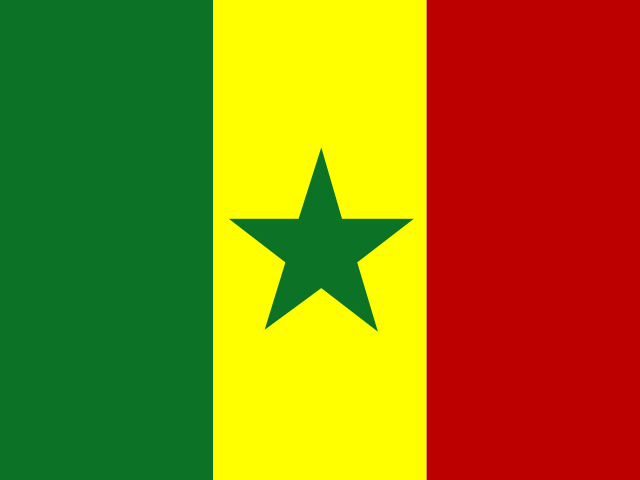
The Constitution of Niger (2010) is structured into several titles, each addressing different aspects of the state's governance and the rights of its citizens. The document begins with a Preamble, followed by Title I: The State and Sovereignty, which outlines the fundamental principles of the Republic of Niger. Title II: Rights and Duties of the Human Person includes various articles on individual rights, including health rights. Title III: Executive Power details the roles and responsibilities of the President and the Government. Title IV: Legislative Power focuses on the functions of the National Assembly. Title V: Relations Between Executive and Legislative Powers describes the interaction between these branches. Title VI: Judicial Power covers the judiciary's independence and structure. Title VII: Economic, Social, and Cultural Development outlines the state's development policies. Title VIII: The Higher Council of Communication addresses media and communication regulations. Title IX: Local Authorities discusses decentralization and local governance. Title X: Treaties and International Agreements covers the process of treaty ratification. Title XI: Cooperation and Association with States focuses on international cooperation. Title XII: Revision details the process for amending the Constitution. Title XIII: Transitional Provisions and Title XIV: Final Provisions conclude the document. Articles 12 and 13 specifically refer to health rights. Article 12 states that everyone has the right to health, and Article 13 emphasizes the state's duty to create conditions ensuring access to medical services and assistance in case of illness.
This Law contains provisions relating to the promotion and protection of the rights of persons with disabilities.
The Nursing and Midwifery Act
This Act makes provisions for the protection, promotion and preservation of public health, safety and welfare through regulation and control of nursing and midwifery education and practice.
The Persons with Disabilities Act
The Act makes provisions for health care, social support, accessibility, rehabilitation and vocational training, communication, employment or work protection and promotion of basic rights for persons with disabilities and provides for related matters.
The law creates the legal framework for civil identification and the issue of national identity cards. The purpose is to collect, process and store the personal data of each citizen in order to establish their civil identity. The law applies to acts of civil identification and the issuing of identity cards to Angolan citizens from the age of at least six.
This Proclamation regulates activities in respect of food, medicine, environmental health, health professionals, health and controllable health related institutions in the country.