

This Decree creates and establishes the rules for the organization and operation of the National Order of Pharmacists of Mauritania (ONPM). This Decree is published in a collection of other legislative acts and can be found on page 10 of the file.
Constitution
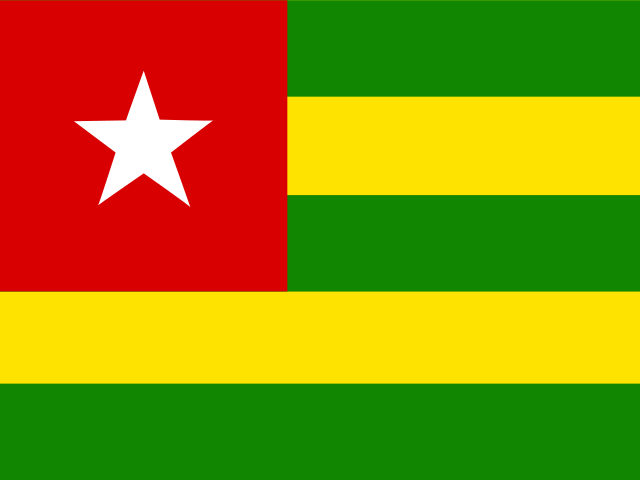
The Constitution was reviewed and adopted in 2019. The Constitution contains 159 articles addressing a large number of issues such as the protection of fundamental rights and freedoms, the fundamental principles of the state and institutional arrangements (non-exhaustive list).
The purpose of the law is to regulate the collection, processing, transmission, storage, use, and protection of personal data.
This Decree provides for the conditions relating to the standards, skills, and ethics in matters of prescription and provision of services in reproductive health, as well as to the sale and administration of contraceptive products and authorized methods of contraception.
This Order establishes the National Program for the Fight against STIs/HIV/AIDS (PNLS) created within the Directorate for the Fight against Diseases at the Ministry of Health.
This Law contributes to the protection of the present and future generations from the devastating health, social and health effects of diseases affecting public health and in particular reproductive health in the Islamic Republic of Mauritania. This Law is published in a collection of other legislative acts and can be found on page 4 of the file.
The decree establishes rules concerning the free movement and establishment of doctors in the West African Economic and Monetary Union.
This Order determines the list of serious or disabling illnesses for which the insured person is entitled to total or partial exemption from payment of the portion of the costs remaining his responsibility, as well as the conditions under which the exemption is granted.
This decree establishes a code of ethics for all physicians practicing in Togo.
This Decree defines the attributions, the organization and the functioning of the Public Hygiene Police of Mauritania.
This Law provides for the extension of the health insurance regime as established by Ordinance No 2005-006 of 29 September 2005 to other population categories such as employees of local authorities and their public establishments; employees of projects and other administrative structures benefiting from financial autonomy; persons exercising a liberal profession; employees and pensioners of the private sector, private law associations and other civil society organizations; professional journalists and private press collaborators; independent workers.
This Law defines the legal provisions relating to medicines, medical devices, other health products and the practice of pharmacy in the Islamic Republic of Mauritania. This Law is published in a collection of other legislative acts and can be found on page 3 of the file.
This Law defines the rules of public health and hygiene in the Islamic Republic of Mauritania, in particular on public spaces, homes, food and non-food products, water, commercial facilities and industries, educational and health establishments, public buildings, and the natural environment. Its main objective is to preserve and promote public health.
The code provides rules regarding different rears of public health. It defines the rights and duties pertaining to the protection and promotion of the health of the population.
The law regulates civil status in Togo. It was published in the Official Journal on 30 June 2009 (pages 6 to 11).
This Decree establishes the rules for the organization and functioning of the National Health Insurance Fund of Mauritania.

Ordonnance No 2005-006 du 29 septembre 2005 portant institution d'un régime d'assurance maladie
This Order establishes the health insurance regime in Mauritania. Specifically, it delineates the groups benefiting from the insurance regime, groups of services guaranteed, financing and reimbursement mechanisms, etc.
This law creates a National Order of Pharmacists.
This law creates a National Order of Physicians.
Constitution
The Constitution of Mauritania was first adopted in 1991 and promulgated by Ordinance No 91.022 of 20 July 1991; it was subsequently re-established and revised in 2006, 2012 and 2017. The Constitution of Mauritania is the supreme law of the state that provides the key values and principles of the organization of the state, provides for the rights, freedoms and obligations of the people, establishes the key state institutes and bodies, etc. The Constitution of Mauritania consists of 102 articles that are grouped into 12 titles.