

The legislation regulates the production, import, export, conservation, distribution, quality analysis and sale of medicines for human use, including traditional medicines, as well as all other health products, pharmaceutical practice and opticianry.
The Decree defines the normative framework for the organization and operation of the Ministry of Public Health and the fight against AIDS.
The purpose of the Act is to establish a biometric identification and authentication system for natural persons.
Constitution
The Constitution was reviewed and adopted in 2019. The Constitution contains 159 articles addressing a large number of issues such as the protection of fundamental rights and freedoms, the fundamental principles of the state and institutional arrangements (non-exhaustive list).
The purpose of the law is to regulate the collection, processing, transmission, storage, use, and protection of personal data.

Loi No 1/012 du 30 mai 2018 portant Code de l'offre des soins et services de sante au Burundi
The law sets out the fundamental principles and rules for the organization and operation of the national public health system.
Loi No 1/03 du 10 janvier 2018 portant promotion et protection des droits handicapées au Burundi
The aim of the law is to promote and protect the rights of persons with disabilities for their effective integration, so that their dignity is preserved and they can benefit from conditions that enable them, where appropriate, to be useful to themselves, their families, their communities and society as a whole by breaking down barriers of all kinds.
The decree establishes rules concerning the free movement and establishment of doctors in the West African Economic and Monetary Union.
This decree establishes a code of ethics for all physicians practicing in Togo.
The code provides rules regarding different rears of public health. It defines the rights and duties pertaining to the protection and promotion of the health of the population.
The law regulates civil status in Togo. It was published in the Official Journal on 30 June 2009 (pages 6 to 11).
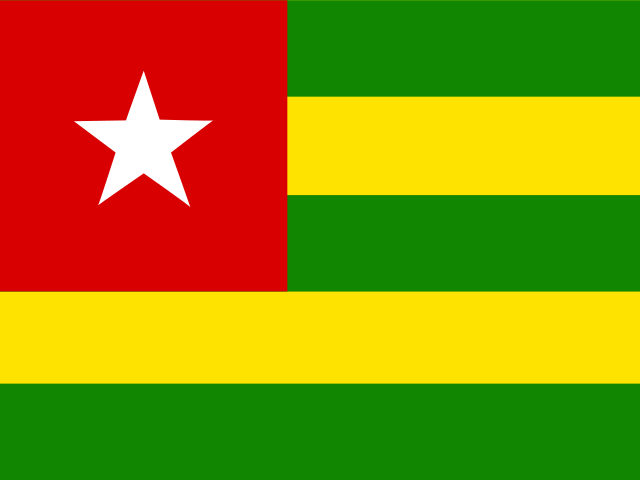
The Constitution was promulgated in 2005 and reviewed in 2018. The Constitution contains 292 articles addressing a broad range of issues as the protection of fundamental rights and freedoms, the fundamental principles of the state and institutional arrangements.
This law creates a National Order of Pharmacists.
This law creates a National Order of Physicians.
The Code provides rules regarding different rears of public health as the prevention and control of communicable diseases; sanitation and housing; and food and water protection among other aspects.
Décret No 100/187 du 4 juin 1974 portant création et organisation de l'Ordre des médecins du Burundi
The Decree creates a public-law institution called the Ordre des Médecins du Burundi. It is responsible for preserving the rules of medical ethics, honor, discretion and dignity of members of the Order in the practice of the medical profession.
The Decree institutes a national identity card.
Code Civil du Burundi
The Burundi Civil Code provides a comprehensive set of laws governing civil matters such as property rights, contracts, family law, and obligations. It consists of 3 books dedicated to (1) Personal and Family Code (2) Of goods and different modifications of property and (3) Contracts or conventional obligations.