

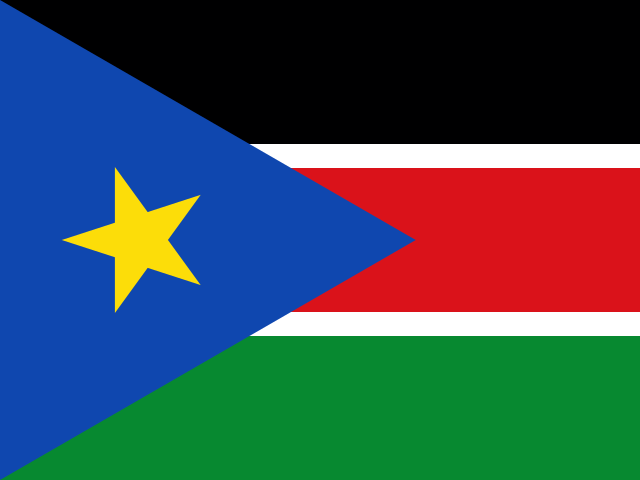
South Sudan Essential Medicines List (SSEML)
The South Sudan Essential Medicines List (SSEML) is a comprehensive list of medications essential for addressing the country's public health needs, prioritizing safe, effective, and affordable treatments for the most common health conditions.
These are the guidelines for the registration, renewal, change in characteristics and extension in range of both imported and locally manufactured registered pharmaceutical products.

Namibia Essential Medicines List
The Namibia Essential Medicines List acts as a guide for the level of availability and use of essential medicines based on the skills levels of health workers as well as the availability of diagnostic facilities at the various levels of the Namibian public sector healthcare system.
National Health Insurance Fund Act

The Pharmacy Council Act
This Act establishes the Pharmacy Council of Mauritius and provides for better regulation of the profession of pharmacists.
National Health Act
This Act provides a framework for a structured uniform health system within Namibia; consolidates the laws relating to state hospitals and state health services, and regulates the conduct of state hospitals and state health services; provides for financial assistance for special medical treatment of State patients; and provides for incidental matters.
Drug and Food Control Authority Act, No 37
This Act provides for the establishment of an independent Drug and Food Control Authority in South Sudan and provide an appropriate and effective independent regulatory mechanism to control and regulate the manufacture, supply, promotion, marketing, advertising, distribution and use of drugs, poisons, chemicals, cosmetics medical devices and food for human or animal use.
Clinical Trials Act
This Act regulates the conduct of clinical trials for medicinal products in Mauritius.
Nationality Regulations
These Regulations outline the rules for acquiring nationality, issuance of the nationality certificates, loss of nationality, civil registry of the South Sudanese nationals, etc.
Constitution
The Constitution of South Sudan was adopted in 2011. It is the supreme law of the state. The Constitution sets out the values and principles of organization of the state, establishes the rights, freedoms and obligations of the people, sets up key state institutions and bodies, etc. The Constitution of South Sudan consists of 200 articles that are grouped into fifteen parts, supplemented by 5 schedules.
DNA Identification Act
This Act establishes the legal framework for the collection, analysis, and use of DNA samples for criminal investigations, paternity testing, and identification purposes and establishes the DNA Population Statistical Database, as well as the Unidentified and Missing Persons Database.
Insurance Act
This Act regulates the private insurance industry by setting out the legal framework for the licensing, operation, and supervision of insurance companies, ensuring solvency, etc.
This Act amends the Medicines and Related Substances Control Act, 2003, so as to amend and delete certain definitions; provides for a period within which the Council must be appointed; provides for the appointment of chairpersons of committees established by the Council; amends provisions relating to the classification of medicines and other substances as scheduled substances; amends provisions relating to the manufacturing, packing and selling of specified Schedule 3 and specified Schedule 4 substances; deletes references to generic substitutions; substitutes references to Schedule 1, Schedule 2, Schedule 3 or Schedule 4 medicines by references to Schedule 1, Schedule 2, Schedule 3 or Schedule 4 substances; inserts provisions relating to the registration of premises engaged in the manufacturing of medicines; amends provisions relating to offences and penalties; amends provisions relating to the destruction of forfeited medicines, scheduled substances or other things; provides for the making of regulations in relation to medicines; amends provisions relating to the exclusion of medicines from the operation of the Act; amends the transitional provisions; amends provisions relating to the repeal and amendment of certain laws; and provides for matters incidental thereto.
These Guidelines provide comprehensive protocols for healthcare workers in South Sudan, outlining evidence-based practices for preventing and treating common diseases and conditions at primary and secondary care levels.
Data Protection Act
This Act establishes the framework for regulation of data protection and establishes the Data Protection Office and its mandate, etc.
Medical and Dental Act
This Act provides for the establishment and constitution of a professional Council for the medical and dental professions; determines the powers, duties and functions of such Council; regulates the registration of medical practitioners and of dentists, and of persons practising certain professions allied to the medical profession or to the dental profession; specifies the education, training and qualifications of persons practising such professions; prohibits the practising of any such profession without being registered; and provides for matters incidental thereto.
Nursing Act
This Act provides for the establishment and constitution of a professional Council for the nursing and midwifery or accoucheury professions; determines the powers, duties and functions of such Council; regulates the registration and enrolment of the members of such professions; specifies the education, training and qualifications of persons practising such professions; prohibits the practising of any such profession without being registered; and provides for matters incidental thereto.
Pharmacy Act
This Act provides for the establishment and constitution of a professional Council for the pharmacy profession; determines the powers, duties and functions of such Council; regulates the registration of pharmacists and persons practising professions allied to the pharmacy profession; specifies the education and training and qualifications of persons practising such professions; prohibits the practising of any such profession without being registered; and provides for matters incidental thereto.
The Nursing Council Act 2003
This Act repeals and replaces the Nursing Council Act of 1992 to make further and better provisions for the establishment, composition and functioning of a Nursing Council, to establish a disciplinary Tribunal and to better regulate and control the nursing and midwifery professions.
This Act provides for the establishment of a Namibia Medicines Regulatory Council; for the registration of medicines intended for human and for animal use; for the control of medicines and scheduled substances and provides for incidental matters.