

This Act establishes a National Health Insurance Authority to implement a national health insurance scheme, establishes a national health insurance Fund to pay for the cost of health care services to members of the Scheme, and provides for the establishment of private health insurance schemes.
This Decree declares the State of Health Emergency and dictates precautionary measures for the prevention, containment and control of the new coronavirus pandemic in the Republic of Equatorial Guinea.
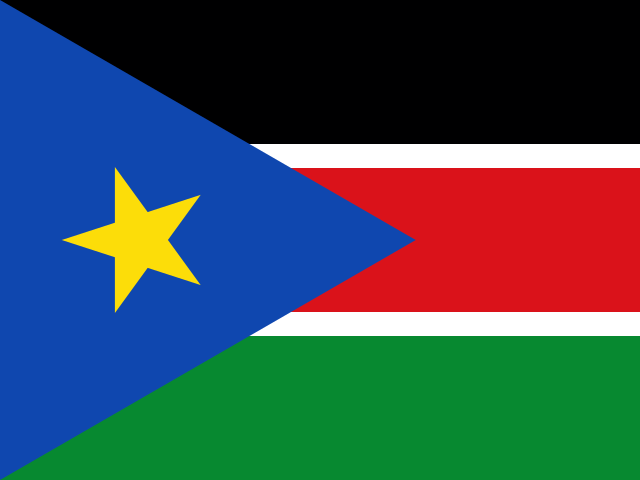
South Sudan Essential Medicines List (SSEML)
The South Sudan Essential Medicines List (SSEML) is a comprehensive list of medications essential for addressing the country's public health needs, prioritizing safe, effective, and affordable treatments for the most common health conditions.
National Health Insurance Fund Act
The Act regulates the quality and safety of medicines and related products and connected matters.

Pharmacy Council Act
This Act promotes and protects the health and safety of the general public through safeguarding, maintaining and enforcing the highest standards in the practice of pharmacy.
Drug and Food Control Authority Act, No 37
This Act provides for the establishment of an independent Drug and Food Control Authority in South Sudan and provide an appropriate and effective independent regulatory mechanism to control and regulate the manufacture, supply, promotion, marketing, advertising, distribution and use of drugs, poisons, chemicals, cosmetics medical devices and food for human or animal use.
Nationality Regulations
These Regulations outline the rules for acquiring nationality, issuance of the nationality certificates, loss of nationality, civil registry of the South Sudanese nationals, etc.
Constitution
The Constitution of South Sudan was adopted in 2011. It is the supreme law of the state. The Constitution sets out the values and principles of organization of the state, establishes the rights, freedoms and obligations of the people, sets up key state institutions and bodies, etc. The Constitution of South Sudan consists of 200 articles that are grouped into fifteen parts, supplemented by 5 schedules.
Women's Act
The Act implement the legal provisions of the National Policy for the advancement of Gambian Women and Girls, and incorporates and enforces the United Nations Convention on the Elimination of all Forms of Discrimination against Women and the Protocol to the African Charter on Human and Peoples' Rights on the Rights of Women in Africa.
The Act provides for the re-structuring, development, and regulation of the information and communication sectors in The Gambia and for matters connected therewith.
This Act provides for integrated and coordinated disaster management that focuses on prevention, preparedness, response, mitigation, and recovery from, disasters or emergency situations, and the management of their effects, establishes a National Disaster Management Agency and Regional, District and Village Disaster Management Committees.

Ley No 7/2006 Reguladora del ejercicio sanitario en Guinea Equatorial
The provisions of this Law govern the practice of medicine. This document is published as a part of a compilation of laws and decrees and this Law is located on page 44 of the file.
Décreto No 107/2006 por el que se toman medidas urgentes para frenar la propagación del VIH/SIDA en La Républica de Guinea Equatorial
This Decree regulates the urgent measures to stop the spread of HIV/AIDS in the Republic of Equatorial Guinea. This document is published as a part of a compilation of laws and decrees and this Decree is located on page 96 of the file.
The Act provides for the establishment of the Royal Victoria Teaching Hospital and its Management Board, and for connected matters.
These Guidelines provide comprehensive protocols for healthcare workers in South Sudan, outlining evidence-based practices for preventing and treating common diseases and conditions at primary and secondary care levels.
Ley No 3/2005 sobre la prevención y la lucha contra las infecciones de transmisión sexual VIH/Sida y la defensa de los derechos humanos de las personas afectadas
The purpose of this Law is to create a legal framework that allows for the implementation of the actions and mechanisms necessary for the education, prevention, treatment, epidemiological surveillance, research, care and monitoring of sexually transmitted infections and HIV/AIDS, as well as to guarantee respect, protection and defence of human rights, and to eliminate the stigmatization and discrimination of people infected with HIV/AIDS. This law can be located on page 24 of the file.
Children's Act
This Act sets out the rights and responsibilities of children, consolidates the laws relating to children, provides for the care, protection and maintenance of children, establishes a Children’s Court, provides for a criminal justice system for children and other connected purposes.
Statistics Act
This Act provides for a sustainable, effective and efficient national statistical system for The Gambia for the collection, production and dissemination of integrated, relevant, reliable, timely statistical information, establishes The Gambia Bureau of Statistics as a supervisory authority for the national statistical system.
Ley No 3/2003 de Medicamentos
The scope of application of this Law includes: medicines and health products, as well as the actions of natural and legal persons involved in the production, marketing, prescription and dispensing of pharmaceutical and health products within the national territory. This document is published as a part of a compilation of laws and decrees and this Law is located on page 2 of the file.