


Data Protection Act, 2022
The Act provides for the collection, processing, disclosure, and protection of personal data.
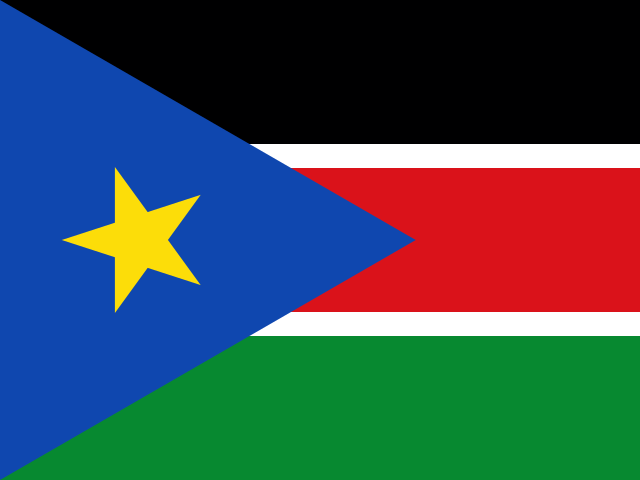
South Sudan Essential Medicines List (SSEML)
The South Sudan Essential Medicines List (SSEML) is a comprehensive list of medications essential for addressing the country's public health needs, prioritizing safe, effective, and affordable treatments for the most common health conditions.
This Act provides for the establishment of a Medicines Regulatory Authority; for the registration of medicines and medical devices; for the control of medicines and scheduled substances, and for incidental matters.
The short title of this Act is the Health Ministry Act. This Act amends the 1972 Act establishing the Ministry of Health and Social Welfare to create and establish the Ministry of Health.
National Health Insurance Fund Act
Tobacco products control Act
The Act gives effect to the World Health Organization 's framework Convention on tobacco control.
This document provides for standard treatment guidelines and the essential medicines list.
Drug and Food Control Authority Act, No 37
This Act provides for the establishment of an independent Drug and Food Control Authority in South Sudan and provide an appropriate and effective independent regulatory mechanism to control and regulate the manufacture, supply, promotion, marketing, advertising, distribution and use of drugs, poisons, chemicals, cosmetics medical devices and food for human or animal use.
Procurement Act, 2011
The Act provides for the regulation and control of practices in respect of public procurement.
This document provides a comprehensive framework for the delivery of essential primary care services and medicines through the community health system.
Nationality Regulations
These Regulations outline the rules for acquiring nationality, issuance of the nationality certificates, loss of nationality, civil registry of the South Sudanese nationals, etc.
Constitution
The Constitution of South Sudan was adopted in 2011. It is the supreme law of the state. The Constitution sets out the values and principles of organization of the state, establishes the rights, freedoms and obligations of the people, sets up key state institutions and bodies, etc. The Constitution of South Sudan consists of 200 articles that are grouped into fifteen parts, supplemented by 5 schedules.
These Guidelines provide comprehensive protocols for healthcare workers in South Sudan, outlining evidence-based practices for preventing and treating common diseases and conditions at primary and secondary care levels.
Constitution
The Constitution includes 279 articles addressing a wide array of issues including the Kingdom and its constitution, the protection and promotion of fundamental rights and freedoms, the acquisition and loss of citizenship, the directive principles of state policy, as well as institutional arrangements (the executive, the legislature, the judicature, local governments, and traditional institutions). The Constitution also addresses public services, public finance, and international relations. (non-exhaustive list).
Standards and Quality Act, 2003
The Act establishes the Swaziland Standards Authority and provides for matters connected thereto.

Constitution
The Constitution of the Republic of Liberia is the supreme law of the state. The Constitution of Liberia establishes the core principles and values of the organization of the state, delineates the division of powers within the states, establishes the key rights, freedoms and obligations, and sets up the core state institutes and bodies. The Constitution of Liberia consists of 97 articles that are grouped into 13 chapters, that are supplemented by one schedule.
The Act provides for the compulsory registration of births, marriages and deaths.
Public Health Law
This Law provides a framework to govern public health in Liberia by focusing on the control of acute communicable diseases and conditions, environmental sanitation, health standards of public and private institutions, regulation of drugs, disposal of human remains, as well as regulation and supervision of medical and allied health professions.
This Act makes provisions regarding the registration and licensing of medical and dental practitioners with a Medical and Dental Council, and provides for matters connected with the practice of these professions.
Public health Act, 1969
This Act makes provisions for public health and connected matters. This includes, among others, providing rules to address communicable diseases and nuisances (e.g. unsuitable dwellings).