


National Budget Highlights
This document provides highlights of the national budget for health for the years 2023-2025.

Data protection Act
This Act provides for data protection measures, and among other things, establishes a Data Protection Authority, provides for their functions, creates a technology-driven business environment and encourages technological development and the lawful use of technology and provides for investigation and collection of evidence of cybercrime and unauthorised data collection and breaches.
Public health Act
This Act provides for public health, the conditions for improvement of the health and quality of life and the health care for all people in Zimbabwe, the rights, duties, powers and functions of all parties in the public health system, and the measures for administration of public health.
Regulations Relating to the Surveillance and the Control of Notifiable Medical Conditions No 604
These Regulations regulate the surveillance and the control of notifiable medical conditions in South Africa.
The document provides the 7th version of the essential medicines list and standard treatment guidelines for Zimbabwe.
Protection of personal information Act No 4 of 2013
The Act promotes the protection of personal information processed by public and private bodies; introduces certain conditions so as to establish minimum requirements for the processing of personal information; provides for the establishment of an Information Regulator to exercise certain powers and to perform certain duties and functions in terms of this Act and the Promotion of Access to Information Act, 2000; provides for the issuing of codes of conduct; provides for the rights of persons regarding unsolicited electronic communications and automated decision making; etc.
Constitution
This Act repeals and substitutes the Constitution of Zimbabwe. The new Constitution, provided in the schedule of the Act, includes 345 articles addressing a wide array of issues including, among others, founding provisions, national objectives, citizenship, declaration of rights, the executive, the legislature, the judiciary and the courts, principles of public administration, civil service and security services, local authorities, corruption etc. (non-exhaustive list).
This Proclamation is to protect the present and future generations from the devastating health, social, environmental and economic consequences of tobacco consumption and exposure to tobacco smoke by providing a legal framework for tobacco control measures, and reduce significantly tobacco use and its consequent harm.
These regulations govern the issuance of work permit to non-nationals.
National Health Act No 61 of 2003
This Act provides a framework for a structured uniform health system within the Republic, taking into account the obligations imposed by the Constitution and other laws on the national, provincial and local governments with regard to health services; and provides for matters connected therewith.
Disaster Management Act No 57 of 2002
This Act provides for an integrated and co-ordinated disaster management policy that focuses on preventing or reducing the risk of disasters, mitigating the severity of disasters, emergency preparedness, rapid and effective response to disasters and post-disaster recovery and rehabilitation; regulates the establishment and functioning of national, provincial and municipal disaster management centres; regulates disaster management volunteers and matters incidental thereto.
These regulations provide for tobacco control measures including tobacco bans, health warnings, advertising restrictions etc.
This proclamation govern employment relations between Eritrean employees and foreign diplomatic missions or international organizations operating in Eritrea, unless other specific agreements to the contrary are concluded with Eritrean Government.
Health Professions Act
This Act covers a broad array of issues pertaining to health and care profession and health facilities. It notably establishes a Health Professions Authority of Zimbabwe, a Medical and Dental Practitioners Council of Zimbabwe, an Allied Health Practitioners Council of Zimbabwe, a Natural Therapists Council of Zimbabwe, a Nurses Council of Zimbabwe, a Pharmacists Council of Zimbabwe, a Medical Laboratory and Clinical Scientists Council of Zimbabwe, an Environmental Health Practitioners Council of Zimbabwe and a Medical Rehabilitation Practitioners Council of Zimbabwe. It further provides for the composition and functions of the Authority and those councils, for the registration of persons in health professions and the issue of practising certificates to registered persons; the exercise of disciplinary powers in relation to registered persons and for the registration and control of health institutions and the regulation of services provided.
Refugees Act No 130 of 1998
This Act gives effect within the Republic of South Africa to the relevant international legal instruments, principles and standards relating to refugees; provides for the reception into South Africa of asylum seekers; regulates applications for and recognition of refugee status; provides for the rights and obligations flowing from such status; and provides for matters connected therewith.
Medical Schemes Act No 131 of 1998
The Act consolidates the laws relating to registered medical schemes; provides for the establishment of the Council for Medical Schemes as a juridical entity; provides for the appointment of the Registrar of Medical Schemes; makes provision for the registration and control of certain activities of medical schemes; protects the interests of members of medical schemes; provides for measures for the co-ordination of medical schemes; and provides for incidental matters.
Medical Services Act, 1998
This Act is to ensure the provision and maintenance of comprehensive hospital services in Zimbabwe; to provide for the admission of persons to Government hospitals and the fixing of fees in respect of services provided thereat; to provide for the granting to medical practitioners and dental practitioners of the privilege of access to certain Government hospitals and for the appointment of consultant medical and dental practitioners; to provide for the registration of medical aid societies; to set conditions for the registration of private hospitals and to provide for matters incidental to or connected with the foregoing.
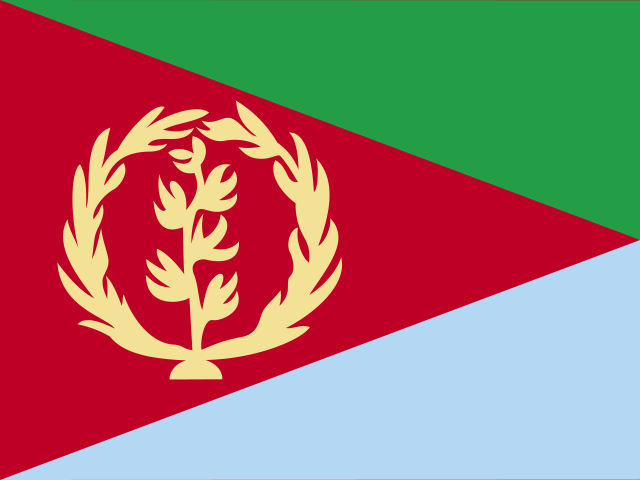
Constitution
The Constitution of Eritrea includes 59 articles addressing, among others, the State's structure, symbols and languages, the National objectives and directive principles, the fundamental rights, freedoms and duties, the institutions in place including the National Assembly, the Executive power, and the judiciary.
Constitution
The Constitution of South Africa was adopted in 1996 and approved by the Constitutional Court. It consists of 241 articles grouped into 14 chapters that are supplemented by 7 schedules. The Constitution is the prime law of the country and sets out the founding provisions of the organization of the state, regulates the civil, political, cultural and economic rights of the people, divides the powers within the state and establishes the key state institutions and organs, etc.
Choice on termination of pregnancy Act 92 of 1996
This Act determines the circumstances in which and conditions under which the pregnancy of a woman may be terminated; and provides for matters connected therewith.