

This document provides the benefits package of the National Health Insurance Scheme as offered to its beneficiaries through private health providers.

Data protection Act
This Act provides for data protection measures, and among other things, establishes a Data Protection Authority, provides for their functions, creates a technology-driven business environment and encourages technological development and the lawful use of technology and provides for investigation and collection of evidence of cybercrime and unauthorised data collection and breaches.
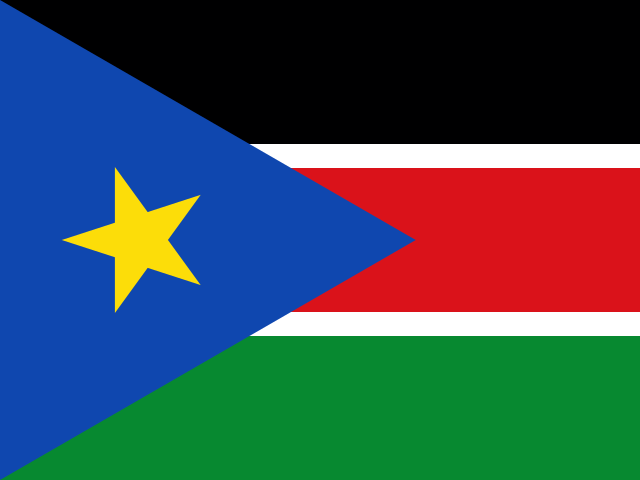
South Sudan Essential Medicines List (SSEML)
The South Sudan Essential Medicines List (SSEML) is a comprehensive list of medications essential for addressing the country's public health needs, prioritizing safe, effective, and affordable treatments for the most common health conditions.
This Act provides for sound financing for the national health system; provides for universal access to quality insured health care services; establishes the National Health Insurance Management Authority and provides for its functions and powers; establishes the National Health Insurance Scheme and provides for its systems, procedures and operation; establishes the National Health Insurance Fund and provides for contributions to and payments from the Fund; provides for accreditation criteria and conditions in respect of insured health care services; provides for complaints and appeals processes; provides for the progressive establishment of provincial and district health offices of the Authority; and provides for matters connected with, or incidental to the foregoing.
Public health Act
This Act provides for public health, the conditions for improvement of the health and quality of life and the health care for all people in Zimbabwe, the rights, duties, powers and functions of all parties in the public health system, and the measures for administration of public health.
National Health Insurance Fund Act
The document provides the 7th version of the essential medicines list and standard treatment guidelines for Zimbabwe.
Constitution
This Act repeals and substitutes the Constitution of Zimbabwe. The new Constitution, provided in the schedule of the Act, includes 345 articles addressing a wide array of issues including, among others, founding provisions, national objectives, citizenship, declaration of rights, the executive, the legislature, the judiciary and the courts, principles of public administration, civil service and security services, local authorities, corruption etc. (non-exhaustive list).
Drug and Food Control Authority Act, No 37
This Act provides for the establishment of an independent Drug and Food Control Authority in South Sudan and provide an appropriate and effective independent regulatory mechanism to control and regulate the manufacture, supply, promotion, marketing, advertising, distribution and use of drugs, poisons, chemicals, cosmetics medical devices and food for human or animal use.
Nationality Regulations
These Regulations outline the rules for acquiring nationality, issuance of the nationality certificates, loss of nationality, civil registry of the South Sudanese nationals, etc.
Constitution
The Constitution of South Sudan was adopted in 2011. It is the supreme law of the state. The Constitution sets out the values and principles of organization of the state, establishes the rights, freedoms and obligations of the people, sets up key state institutions and bodies, etc. The Constitution of South Sudan consists of 200 articles that are grouped into fifteen parts, supplemented by 5 schedules.
These Guidelines provide comprehensive protocols for healthcare workers in South Sudan, outlining evidence-based practices for preventing and treating common diseases and conditions at primary and secondary care levels.
These regulations provide for tobacco control measures including tobacco bans, health warnings, advertising restrictions etc.
Health Professions Act
This Act covers a broad array of issues pertaining to health and care profession and health facilities. It notably establishes a Health Professions Authority of Zimbabwe, a Medical and Dental Practitioners Council of Zimbabwe, an Allied Health Practitioners Council of Zimbabwe, a Natural Therapists Council of Zimbabwe, a Nurses Council of Zimbabwe, a Pharmacists Council of Zimbabwe, a Medical Laboratory and Clinical Scientists Council of Zimbabwe, an Environmental Health Practitioners Council of Zimbabwe and a Medical Rehabilitation Practitioners Council of Zimbabwe. It further provides for the composition and functions of the Authority and those councils, for the registration of persons in health professions and the issue of practising certificates to registered persons; the exercise of disciplinary powers in relation to registered persons and for the registration and control of health institutions and the regulation of services provided.
Medical Services Act, 1998
This Act is to ensure the provision and maintenance of comprehensive hospital services in Zimbabwe; to provide for the admission of persons to Government hospitals and the fixing of fees in respect of services provided thereat; to provide for the granting to medical practitioners and dental practitioners of the privilege of access to certain Government hospitals and for the appointment of consultant medical and dental practitioners; to provide for the registration of medical aid societies; to set conditions for the registration of private hospitals and to provide for matters incidental to or connected with the foregoing.

Constitution
The Constitution of Zambia was adopted in 1991 and was amended in 2016 by Act No 2 titled "An Act to Amend the Constitution of Zambia". The Constitution of Zambia is the supreme law of the country that establishes the core values and principles of the state, provides for the core rights, freedoms and duties, separates the powers within the state and establishes the key state institutes.
Births and Deaths registration Act
This Act provides for the registration of births and deaths in Zimbabwe.
This Act establishes the Zimbabwe National Family Planning Council and provides for its structure, functions and powers. It further provides for reproductive health and family planning services in Zimbabwe and the promotion and implementation of population and development primary health care and other community-based development programmes relating to family health and for the integration and co-ordination of other relevant activities in Government departments, Nongovernmental organizations and the Private sector.
National registration Act
This Act provides for the registration of persons resident in Zimbabwe and for the issue of identity documents; it further imposes obligations regarding the carrying of identity documents.
This Act provides for a uniform law for the registration of all births and deaths in Zambia, without distinction of origin or descent; and provides for matters incidental thereto.