


Data Protection Act, 2022
The Act provides for the collection, processing, disclosure, and protection of personal data.
This Decree declares the State of Health Emergency and dictates precautionary measures for the prevention, containment and control of the new coronavirus pandemic in the Republic of Equatorial Guinea.
This Act provides for the establishment of a Medicines Regulatory Authority; for the registration of medicines and medical devices; for the control of medicines and scheduled substances, and for incidental matters.
Tobacco products control Act
The Act gives effect to the World Health Organization 's framework Convention on tobacco control.
This document provides for standard treatment guidelines and the essential medicines list.
Procurement Act, 2011
The Act provides for the regulation and control of practices in respect of public procurement.

Ley No 7/2006 Reguladora del ejercicio sanitario en Guinea Equatorial
The provisions of this Law govern the practice of medicine. This document is published as a part of a compilation of laws and decrees and this Law is located on page 44 of the file.
Décreto No 107/2006 por el que se toman medidas urgentes para frenar la propagación del VIH/SIDA en La Républica de Guinea Equatorial
This Decree regulates the urgent measures to stop the spread of HIV/AIDS in the Republic of Equatorial Guinea. This document is published as a part of a compilation of laws and decrees and this Decree is located on page 96 of the file.
Ley No 3/2005 sobre la prevención y la lucha contra las infecciones de transmisión sexual VIH/Sida y la defensa de los derechos humanos de las personas afectadas
The purpose of this Law is to create a legal framework that allows for the implementation of the actions and mechanisms necessary for the education, prevention, treatment, epidemiological surveillance, research, care and monitoring of sexually transmitted infections and HIV/AIDS, as well as to guarantee respect, protection and defence of human rights, and to eliminate the stigmatization and discrimination of people infected with HIV/AIDS. This law can be located on page 24 of the file.
Constitution
The Constitution includes 279 articles addressing a wide array of issues including the Kingdom and its constitution, the protection and promotion of fundamental rights and freedoms, the acquisition and loss of citizenship, the directive principles of state policy, as well as institutional arrangements (the executive, the legislature, the judicature, local governments, and traditional institutions). The Constitution also addresses public services, public finance, and international relations. (non-exhaustive list).
This Proclamation is to protect the present and future generations from the devastating health, social, environmental and economic consequences of tobacco consumption and exposure to tobacco smoke by providing a legal framework for tobacco control measures, and reduce significantly tobacco use and its consequent harm.
Ley No 3/2003 de Medicamentos
The scope of application of this Law includes: medicines and health products, as well as the actions of natural and legal persons involved in the production, marketing, prescription and dispensing of pharmaceutical and health products within the national territory. This document is published as a part of a compilation of laws and decrees and this Law is located on page 2 of the file.
These regulations govern the issuance of work permit to non-nationals.
Standards and Quality Act, 2003
The Act establishes the Swaziland Standards Authority and provides for matters connected thereto.
Décreto No 78/2001 por el que se aprueban el Plan Marco Estratégico y el Plan de urgencia de Lucha contra el SIDA en Guinea Equatorial
This Decree approves the Strategic Framework Plan and the Emergency Plan for the Fight against AIDS in Equatorial Guinea. This document is published as a part of a compilation of laws and decrees and this Decree is located on page 81 of the file.
This proclamation govern employment relations between Eritrean employees and foreign diplomatic missions or international organizations operating in Eritrea, unless other specific agreements to the contrary are concluded with Eritrean Government.
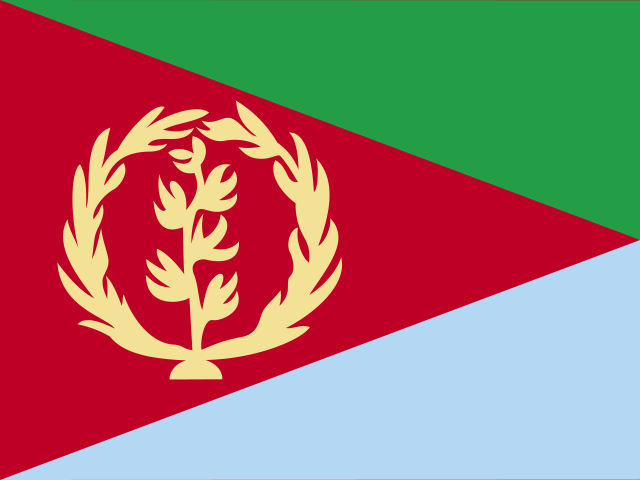
Constitution
The Constitution of Eritrea includes 59 articles addressing, among others, the State's structure, symbols and languages, the National objectives and directive principles, the fundamental rights, freedoms and duties, the institutions in place including the National Assembly, the Executive power, and the judiciary.
This proclamation determines the structure, powers and functions of the Government of Eritrea.
This proclamation provides rules to control drugs, medical supplies and sanitary items.
Constitution
The Constitution of Equatorial Guinea was first adopted in 1991 and revised in 2012. It consists of 134 articles that are grouped into five titles. The Constitution establishes a wide array of norms touching upon the questions of hierarchy of laws, type of government in the country, civil, economic and political rights, human rights and freedoms, organization of the state, separation of powers, etc.