


This Decree sets the operation modalities for some health competencies transferred by the State to the regions.
The Constitution of Chad was reviewed and approved by the referendum of the 17 December 2023. The Constitution contains 290 articles addressing a large number of issues as the protection of fundamental rights and freedoms, the fundamental principles of the state and institutional arrangements.
The Constitution of Mali was adopted by referendum and promulgated in 2023. The Constitution contains 191 articles addressing a wide array of issues, such as the protection of fundamental rights, the fundamental principles of the state and institutional arrangements.

Constitution
The Constitution was adopted by referendum in November 2020 and has been promulgated by Presidential decree n°20-442. It includes 225 articles addressing a wide array of issues including Fundamental Principles for the Society, Fundamental Rights, Freedoms and Duties, and Organization and Separation of Powers (non-exhaustive list).

Constitution
The Constitution of Guinea was reviewed in 2020. The Constitution contains 156 articles addressing a large number of issues as the protection of fundamental rights and freedoms, the fundamental principles of the state and institutional arrangements.
This Law amends and supplements Articles 185 and 195 of Law No 2013-10 relating to the General Code of Local Authorities
Constitution
The Constitution was reviewed and adopted in 2019. The Constitution contains 159 articles addressing a large number of issues such as the protection of fundamental rights and freedoms, the fundamental principles of the state and institutional arrangements (non-exhaustive list).

Constitution
The Constitution of Chad is the supreme law of the country and outlines the fundamental principles and framework of the government.

The Constitution of Comoros was adopted in 2001 and last amended in 2018. The Constitution contains 122 articles addressing a large number of issues as the protection of fundamental rights and freedoms, the fundamental principles of the state and institutional arrangements.

The law modifies the articles 8, 135,137,139,159,160,166,195,204,226,244,250,275,292 and the title XII of the Constitution of the Republic of Mozambique.

Public health Act
This Act provides for public health, the conditions for improvement of the health and quality of life and the health care for all people in Zimbabwe, the rights, duties, powers and functions of all parties in the public health system, and the measures for administration of public health.

The Local Governance (Amendment) Act of 2017 amends the Local Governance Act, 2016 (Act 936) to provide for the discretion of the President to revoke the appointment of an appointed member of a District Assembly.

Constitution
The Constitution was promulgated by the Law N° 2016-886 of 8 November 2016 and modified by constitutional law N° 2020-348 of 19 March 2020. It includes 184 articles addressing a wide array of issues including among other things fundamental freedoms, duties and rights, the fundamental principles of the Republic and institutional arrangements.
The Local Governance Act (Act 936) of 2016 provides for local governance in accordance with the Constitution; establishes a Local Government Service; provides for the establishment and administration of the District Assemblies Common Fund; provides for a National Development Planning System; defines and regulates planning procedures of District Assemblies; co-ordinates, facilitates, monitors and supervises internal audit activities within District Assemblies and related matters.
Constitution
The Constitution includes 246 articles addressing among other, the State and Sovereignty, Fundamental Rights and Freedoms, institutions in place (e.g., executive power, legislative power, and judicial power ) as well as established councils such as the Economic, social and environmental council, the superior council of the freedom of communication or the national consultative councils (non-exhaustive list).

Public Health Act
This Act repeals and replaces the Public Health Act (Cap 198). The Act provides the legal framework for the protection and improvement of public health, regulates issues such as sanitation, disease control, environmental health and health care services.

Law No 87/2013 determining the organisation and functioning of decentralised administrative bodies
This Law determines the organization and functioning of the decentralised administrative entities.
This is a General Code of Local Authorities of Senegal.
Constitution
This Act repeals and substitutes the Constitution of Zimbabwe. The new Constitution, provided in the schedule of the Act, includes 345 articles addressing a wide array of issues including, among others, founding provisions, national objectives, citizenship, declaration of rights, the executive, the legislature, the judiciary and the courts, principles of public administration, civil service and security services, local authorities, corruption etc. (non-exhaustive list).
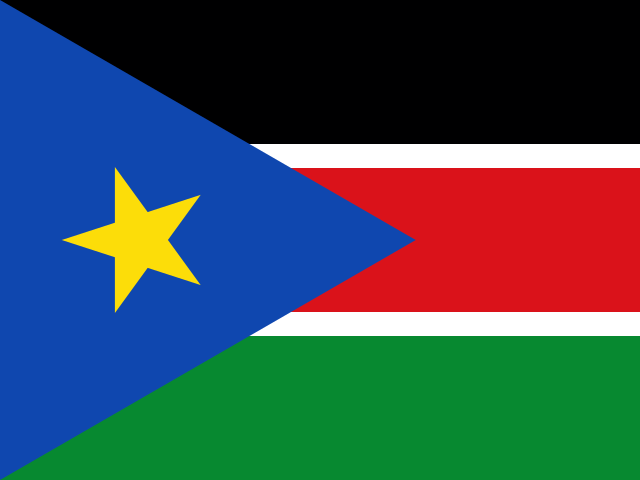
Constitution
The Constitution of South Sudan was adopted in 2011. It is the supreme law of the state. The Constitution sets out the values and principles of organization of the state, establishes the rights, freedoms and obligations of the people, sets up key state institutions and bodies, etc. The Constitution of South Sudan consists of 200 articles that are grouped into fifteen parts, supplemented by 5 schedules.