


Constitution
The Constitution of Rwanda was promulgated in 2003 and reviewed in 2015. The Constitution contains 177 articles addressing a large number of issues as the protection of fundamental rights and freedoms, fundamental principles of the state and institutional arrangements.

Constituição
The Constitution of Sao Tome and Principe was promulgated by a Law No 1/2003. The Constitution of Sao Tome and Principe is the supreme law of the state that sets out the key values and principles of organization of the state, establishes rights, freedoms and obligations of the people, sets up the key bodies and institutes of the state, provides for the division of the powers within the country, etc. The Constitution of Sao Tome and Principe consists of 160 articles that are grouped into 5 parts.
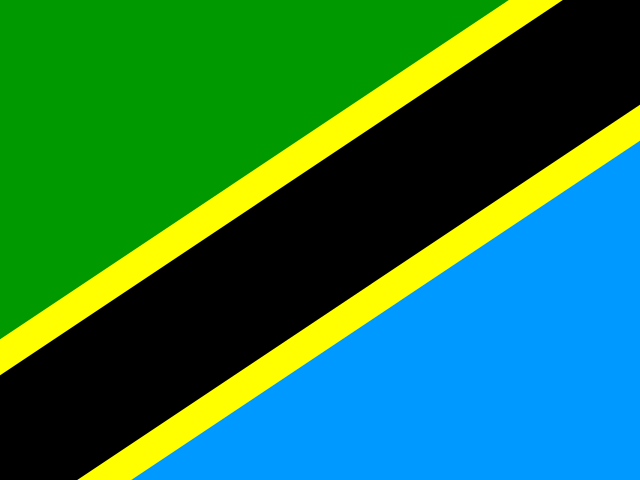
The Occupational Health and Safety Act
This Act repeals the Factories Ordinance; makes provisions for the safety, health and welfare of persons at work in factories and other places of work; provides for the protection of persons other than persons at work against hazards to health and safety arising out of or in connection with activities of persons at work; and provides for connected matters.

Loi No 021/2002 portant statut des refugies en République Démocratique du Congo
This Law establishes provisions on the status of refugees and related matters in the Democratic Republic of the Congo.

The Local Government Act
The Act establishes and regulates a decentralised local government system for the Gambia; it makes provision for the functions, powers and duties of local authorities and for matters connected therewith.

Constitution
The Constitution of Senegal was adopted 2001 and promulgated by law No 2001-03 of 22 January 2001. The Constitution consists of 103 articles that are grouped into 12 titles. The Constitution establishes key principles and values of the state, provides for the separation of powers, establishes the rights and freedoms of the people, sets up the key state organs and their mandates, etc.

Local Government Act
This Act amends and consolidates the law relating to local government and provides for the matters connected therewith and incidental thereto.

The Constitution of Nigeria was promulgated in 1999 and reviewed in 2023. The Constitution contains 320 articles addressing a large number of issues as the protection of fundamental rights and freedoms, the fundamental principles of the state and institutional arrangements (see more below).

The Children's Act of 1998 reforms and consolidates the law relating to children, provides for the rights of the child, maintenance and adoption, regulates child labour and apprenticeship, for ancillary matters concerning children generally and provides for related matters.

Refugees Act No 130 of 1998
This Act gives effect within the Republic of South Africa to the relevant international legal instruments, principles and standards relating to refugees; provides for the reception into South Africa of asylum seekers; regulates applications for and recognition of refugee status; provides for the rights and obligations flowing from such status; and provides for matters connected therewith.
The Refugees Act
This Act makes provisions for the Enactment of the Refugees Act, National Eligibility Committee, Asylum seeker and Refugee administration and repeals the Refugee (Control) Act and provides for connected matters.
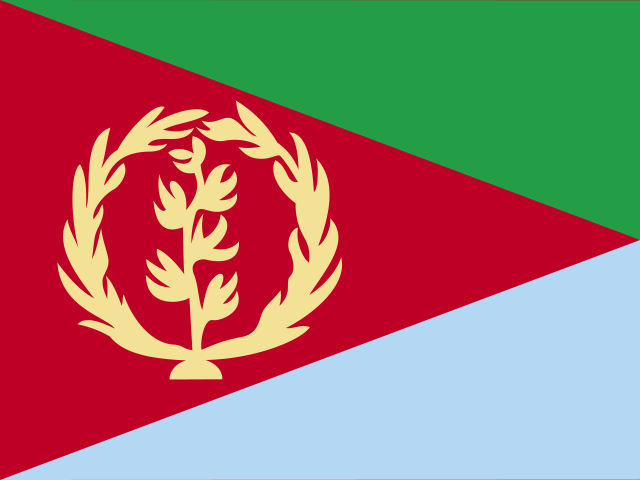
Constitution
The Constitution of Eritrea includes 59 articles addressing, among others, the State's structure, symbols and languages, the National objectives and directive principles, the fundamental rights, freedoms and duties, the institutions in place including the National Assembly, the Executive power, and the judiciary.
Constitution
The Constitution of the Gambia was adopted in 1997. It is the supreme law of the country and consists of 232 articles that are grouped into 23 chapters. The Constitution sets out the values and principles of the state, defines supremacy rules for the law, proclaims fundamental rights and freedoms, establishes key bodies of the state, etc.
This Act makes provision for the regulation of the conditions of employment in workplaces as regards the safety, health and welfare of persons employed therein; for the inspection of certain plant and machinery, and the prevention and regulation of accidents occurring to persons employed or authorized to go into the workplaces; and provides for matters connected with or incidental to the foregoing.
Constitution
The Constitution of the United Republic of Tanzania was adopted in 1977 and amended in 2005. The Constitution is the supreme law of the country and establishes the state principles, regulates the separation of powers, establishes key government structures and their mandates, establishes rights, etc. The Constitution consists of 152 articles that are organized into ten chapters that are supplemented by two schedules.

The decree N°96-68 addresses the creation, missions, organization and operation of the Inspectorate-General of the Ministry of Health and Population. The text of the decree is provided as part of a compendium of health-related legislation (see pages 22-.24).

Income Tax Act
This Act governs the taxation of individuals, companies and other entities in Mauritius and outlines rules for income tax, tax rates, deductions, exemptions and the administration of tax collection, etc.

The decree creates a technical-administrative division known as a health district for towns, departments, arrondissements and communes. The Health District is the local level for the design, planning, implementation, monitoring and evaluation of health policy.
Constitution
The Constitution of South Africa was adopted in 1996 and approved by the Constitutional Court. It consists of 241 articles grouped into 14 chapters that are supplemented by 7 schedules. The Constitution is the prime law of the country and sets out the founding provisions of the organization of the state, regulates the civil, political, cultural and economic rights of the people, divides the powers within the state and establishes the key state institutions and organs, etc.
Choice on termination of pregnancy Act 92 of 1996
This Act determines the circumstances in which and conditions under which the pregnancy of a woman may be terminated; and provides for matters connected therewith.