


This Decree approves the amended statutes of the Beninese pharmaceutical regulatory agency, now named “Beninese Agency for Medicines and other Health Products”.

The Constitution of Chad was reviewed and approved by the referendum of the 17 December 2023. The Constitution contains 290 articles addressing a large number of issues as the protection of fundamental rights and freedoms, the fundamental principles of the state and institutional arrangements.

The Constitution of Mali was adopted by referendum and promulgated in 2023. The Constitution contains 191 articles addressing a wide array of issues, such as the protection of fundamental rights, the fundamental principles of the state and institutional arrangements.

This decree, taken in application of the provisions of articles 22, 29 and 30 of Law No. 20/2005 of January 3, 2006, provides for the creation, attributions, organization and operation of the Public Health Emergency Operations Center in the Gabonese Republic, abbreviated to COUSP.

The Decree sets out the statutes of the Nigerian Pharmaceutical Regulatory Agency.

This Decree establishes and fixes the rules of organization and operation of the Senegalese Pharmaceutical Regulatory Agency (ARP)

The law creates the Burundian Authority for the Regulation of Medicines for Human Use and Food. The authority's general aim is to protect public health by promoting the quality and safety of products such as prefabricated and ambient foods, medicines for human use, cosmetics and dietary products containing active ingredients, herbal medicines, traditional medicines, and medical devices, among others.
The law authorized the extension of the state of health emergency in 2021.
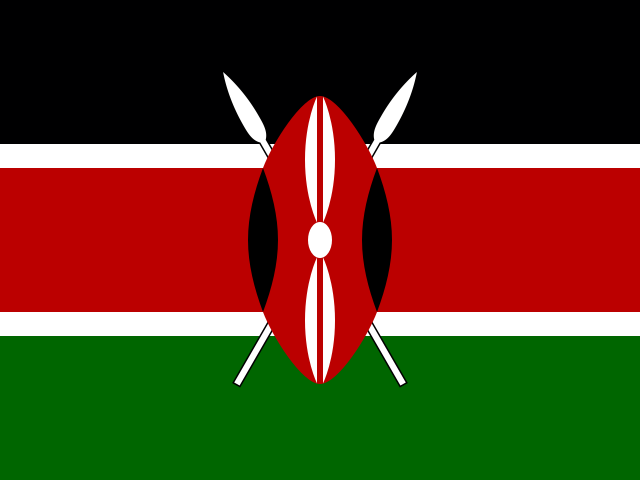
The Kenya National Framework for the Organization of Trauma Services is the first-ever guidance in Kenya to establish a working Trauma Care System as a key component of the healthcare system. The framework highlights the key components required to provide quality continuum of care, which includes injury prevention, pre-hospital care, hospital, and rehabilitation care.
The Kenya Public Health Emergency Operations Center (KPHEOC) Standard Operating Procedures (SOPs) are part of the Ministry of Health Preparedness System. This SOP describes the procedures for activating, operating, and deactivating the KPHEOC.
The Kenya Public Health Emergency Supply Chain Framework provides guidance regarding preparedness and response for emergency operations in the country. The Emergency Supply Chain Framework was developed to enable the Public Health Emergency Operations Centre efficiently deploy medical countermeasures (MCMs) during emergencies.

Public health (Covid 19) (Risk determination and Mitigation measures) (N°5) Regulations, 2021
The document has the regulation taken by Lesotho’s government during the emergency of COVID 19.

Constitution
The Constitution was adopted by referendum in November 2020 and has been promulgated by Presidential decree n°20-442. It includes 225 articles addressing a wide array of issues including Fundamental Principles for the Society, Fundamental Rights, Freedoms and Duties, and Organization and Separation of Powers (non-exhaustive list).

This Order provides for the creation of the Centre de Coordination des Opérations d'Urgences de Santé abbreviated to ‘CCOUSP’ (coordination center for health emergency operations).

This Decree declares the State of Health Emergency and dictates precautionary measures for the prevention, containment and control of the new coronavirus pandemic in the Republic of Equatorial Guinea.
This law, taken in application of the provisions of article 47 of the Constitution, establishes the measures for the prevention, fight and response to health disasters.

Constitution
The Constitution of Guinea was reviewed in 2020. The Constitution contains 156 articles addressing a large number of issues as the protection of fundamental rights and freedoms, the fundamental principles of the state and institutional arrangements.
The document contains regulation taken by Lesotho’s government during the emergency of COVID 19.
This Law establishes the Disaster Risk Management and Reduction Legal Regime, which comprises risk reduction, disaster management, sustainable recovery for building human, infrastructural and ecosystem resilience, as well as adaptation to climate change.

Decreto No 115/2020 Aprova o Estatuto Orgânico da Autoridade Nacional Reguladora de Medicamento
The Decree approves the Organic Statute of the Autoridade Nacional Reguladora de Medicamento (The National Medicines Regulatory Authority). The purpose of this Decree is to define the rules governing the organization, management and operation, as well as the powers of its bodies.