


This Executive Decree No 06-370 of 26 Ramadhan 1427 governs the creation, organization and operation of the national fund for the collection of social security contributions. It was published in the Official Journal on 28 October 2006 (pages 9-14).

Constitution
The Constitution of the Democratic Republic of the Congo was adopted in 2006 and revised by Law No 11/002 of 20 January 2011. The Constitution consists of 229 articles that are grouped into eight titles. The Constitution includes provisions on the key principles of the organization of the Republic, human rights and fundamental freedoms, organization of powers, key state organs, etc.
This Decree establishes the rules for the organization and functioning of the National Health Insurance Fund of Mauritania.

The Constitution was promulgated in 2005 and reviewed in 2018. The Constitution contains 292 articles addressing a broad range of issues as the protection of fundamental rights and freedoms, the fundamental principles of the state and institutional arrangements.

Constitution
The Constitution includes 279 articles addressing a wide array of issues including the Kingdom and its constitution, the protection and promotion of fundamental rights and freedoms, the acquisition and loss of citizenship, the directive principles of state policy, as well as institutional arrangements (the executive, the legislature, the judicature, local governments, and traditional institutions). The Constitution also addresses public services, public finance, and international relations. (non-exhaustive list).

Ordonnance No 2005-006 du 29 septembre 2005 portant institution d'un régime d'assurance maladie
This Order establishes the health insurance regime in Mauritania. Specifically, it delineates the groups benefiting from the insurance regime, groups of services guaranteed, financing and reimbursement mechanisms, etc.

The Decree sets out the statutes of the social public establishment called the “Caisse nationale de sécurité sociale” (National Social Security Fund).

The National Health Insurance Regulations of 2004 govern the registration, management, and oversight of health insurance schemes licensed under the Health Insurance Act of 2003, detailing requirements for licensing conditions, and fees. They mandate non-discrimination, set minimum benefit standards, and outline procedures for interim management and the accreditation of healthcare facilities.

Constituição
The Constitution was promulgated in 2004 and modified in 2018. It includes 306 articles (17 titles) addressing a large number of issues as the protection of fundamental rights and freedoms, the fundamental principles of the state and institutional arrangements.
The law creates a social public establishment called the “Caisse nationale de sécurité sociale” (National Social Security Fund). The purpose of the Caisse Nationale de Sécurité Sociale is to manage the various branches of social security set up for workers, such as family benefits; prevention and compensation for occupational accidents and diseases; and old-age, invalidity and survivors' pensions. It is also responsible for managing the health and social action fund. It may also be entrusted with the management of other social security branches.

Constitution
The Constitution of Rwanda was promulgated in 2003 and reviewed in 2015. The Constitution contains 177 articles addressing a large number of issues as the protection of fundamental rights and freedoms, fundamental principles of the state and institutional arrangements.

Constituição
The Constitution of Sao Tome and Principe was promulgated by a Law No 1/2003. The Constitution of Sao Tome and Principe is the supreme law of the state that sets out the key values and principles of organization of the state, establishes rights, freedoms and obligations of the people, sets up the key bodies and institutes of the state, provides for the division of the powers within the country, etc. The Constitution of Sao Tome and Principe consists of 160 articles that are grouped into 5 parts.
This Law establishes the Health Insurance Scheme for Government Employees in Rwanda. It also determines its functioning and beneficiaries.
Constitution
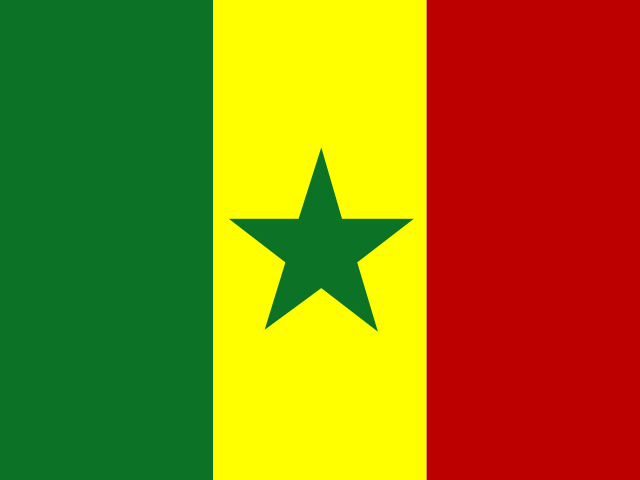
The Constitution of Senegal was adopted 2001 and promulgated by law No 2001-03 of 22 January 2001. The Constitution consists of 103 articles that are grouped into 12 titles. The Constitution establishes key principles and values of the state, provides for the separation of powers, establishes the rights and freedoms of the people, sets up the key state organs and their mandates, etc.

The Code provides for the "Caisse Nationale de Prévoyance Sociale" (CNPS) whose tasked is to provide benefits to salaried employees to alleviate the financial consequences of certain risks or situations such as accident at work and occupational diseases, maternity, retirement, invalidity and death and family allowances (art. 1 and 5).

The Constitution of Nigeria was promulgated in 1999 and reviewed in 2023. The Constitution contains 320 articles addressing a large number of issues as the protection of fundamental rights and freedoms, the fundamental principles of the state and institutional arrangements (see more below).

Medical Schemes Act No 131 of 1998
The Act consolidates the laws relating to registered medical schemes; provides for the establishment of the Council for Medical Schemes as a juridical entity; provides for the appointment of the Registrar of Medical Schemes; makes provision for the registration and control of certain activities of medical schemes; protects the interests of members of medical schemes; provides for measures for the co-ordination of medical schemes; and provides for incidental matters.
Constitution
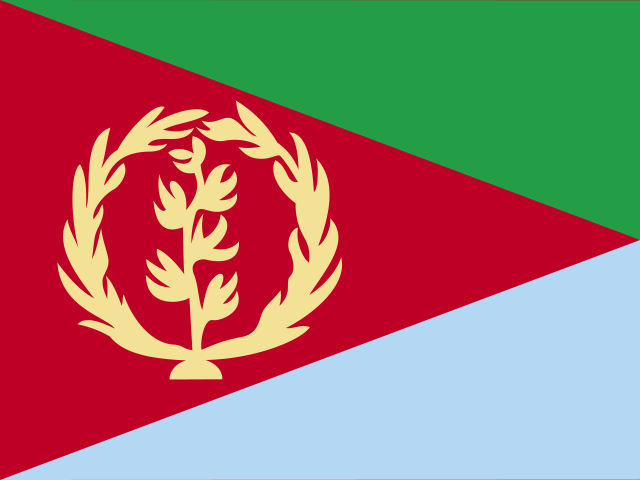
The Constitution of Eritrea includes 59 articles addressing, among others, the State's structure, symbols and languages, the National objectives and directive principles, the fundamental rights, freedoms and duties, the institutions in place including the National Assembly, the Executive power, and the judiciary.

Constitution
The Constitution of the Gambia was adopted in 1997. It is the supreme law of the country and consists of 232 articles that are grouped into 23 chapters. The Constitution sets out the values and principles of the state, defines supremacy rules for the law, proclaims fundamental rights and freedoms, establishes key bodies of the state, etc.
Constitution
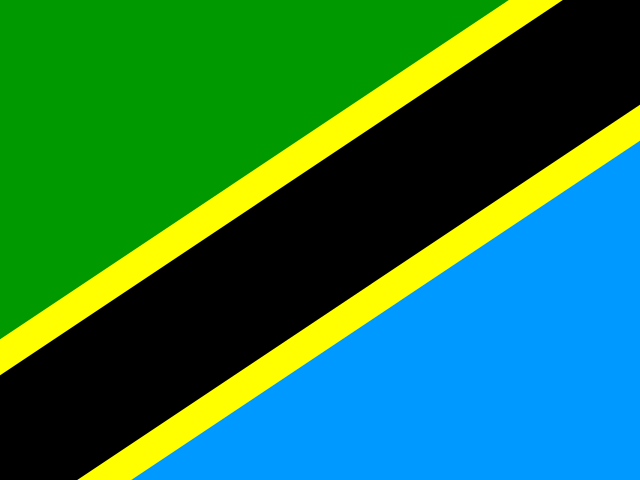
The Constitution of the United Republic of Tanzania was adopted in 1977 and amended in 2005. The Constitution is the supreme law of the country and establishes the state principles, regulates the separation of powers, establishes key government structures and their mandates, establishes rights, etc. The Constitution consists of 152 articles that are organized into ten chapters that are supplemented by two schedules.