


This Decree approves the amended statutes of the Beninese pharmaceutical regulatory agency, now named “Beninese Agency for Medicines and other Health Products”.

The objective of this law is to provide the rules relating to public hygiene and sanitation in rural and urban areas.
The Act amended the National Identity Cards Act, 2011.

The law determines the essential rules relating to public health and hygiene in the Republic of Niger. The law contains articles referring to the fundamental principles of health in Niger, such as the functioning of the national health system, or health information; as well as the fundamental principles of hygiene, such as urban health and food safety.
The Decree sets out the statutes of the Nigerian Pharmaceutical Regulatory Agency.

This Decree establishes and fixes the rules of organization and operation of the Senegalese Pharmaceutical Regulatory Agency (ARP)

The law creates the Burundian Authority for the Regulation of Medicines for Human Use and Food. The authority's general aim is to protect public health by promoting the quality and safety of products such as prefabricated and ambient foods, medicines for human use, cosmetics and dietary products containing active ingredients, herbal medicines, traditional medicines, and medical devices, among others.

Decreto No 115/2020 Aprova o Estatuto Orgânico da Autoridade Nacional Reguladora de Medicamento
The Decree approves the Organic Statute of the Autoridade Nacional Reguladora de Medicamento (The National Medicines Regulatory Authority). The purpose of this Decree is to define the rules governing the organization, management and operation, as well as the powers of its bodies.
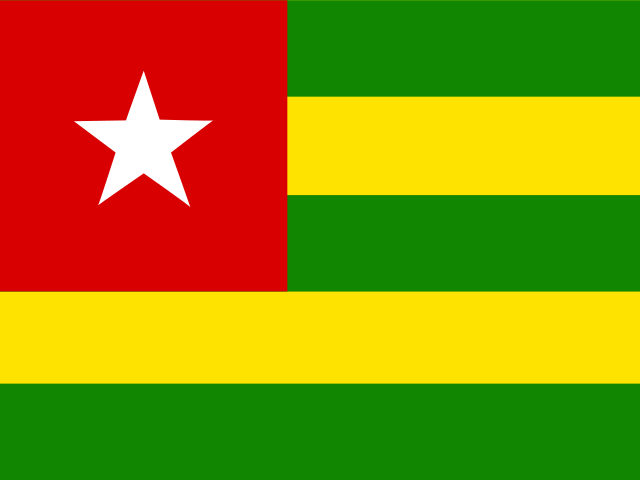
The purpose of the Act is to establish a biometric identification and authentication system for natural persons.

This Act establishes the Pharmacy and Medicines Regulatory Authority; provides for the functions and powers of the Authority; and provides for matters connected therewith and incidental thereto.

This Law amended the Law n°14/2008 governing registration of the population and issuance of the national identity card.

The law institutes in Burkina Faso an Economic Community of West African States (ECOWAS) biometric identity card with an electronic chip. The ECOWAS identity card is an official identification document required for all civil acts.
The objective of the law is to establish an institutional framework for regulating the pharmaceutical sector to ensure market approval and use of pharmaceutical products that are accessible, safe, efficient, and of appropriate quality (art.2). It notably establishes the Authority for pharmaceutical regulation (Autorité Ivoirienne de Regulation Pharmaceutique - AIRP) and addresses its mandates (chapter 1).

The National Medical Supplies Agency Act
This Act repeals and replaces the National Pharmaceutical Procurement Unit Act, 2012 to establish the National Medical Supplies Agency as a public service agency responsible for the procurement, warehousing and distribution of drugs and medical supplies in a transparent and cost-effective manner for and on behalf of all public institutions throughout Sierra Leone.

This Act provides for the establishment of a Medicines Regulatory Authority; for the registration of medicines and medical devices; for the control of medicines and scheduled substances, and for incidental matters.
This Law establishes a biometric identity card.

Decreto-Lei No 19/2014
This decree creates the National Identification Card for Cape Verdean citizens and establishes the framework for its issue, replacement, use and cancellation.

This Decree defines the attributions, the organization and the functioning of the Public Hygiene Police of Mauritania.

National Identity Cards Act 2011
The Act mandates the establishment of a National Identity Register, the issuance of national identity cards to persons whose are included in the national identity register and for related matters.
This Law defines the rules of public health and hygiene in the Islamic Republic of Mauritania, in particular on public spaces, homes, food and non-food products, water, commercial facilities and industries, educational and health establishments, public buildings, and the natural environment. Its main objective is to preserve and promote public health.