

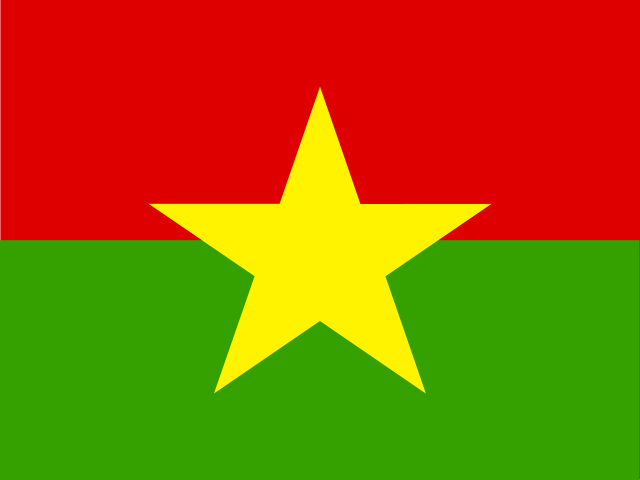
Constitution du Burkina Faso
The Constitution was promulgated in June 1991 and modified in 2015. It includes 169 articles organized around 16 titles covering a broad array of issues including fundamental rights and freedoms and institutional arrangements.

Constitution
The Constitution of Equatorial Guinea was first adopted in 1991 and revised in 2012. It consists of 134 articles that are grouped into five titles. The Constitution establishes a wide array of norms touching upon the questions of hierarchy of laws, type of government in the country, civil, economic and political rights, human rights and freedoms, organization of the state, separation of powers, etc.

The Constitution of Gabon was adopted in 1991 and promulgated by Law No 3/91 on 26 of March 1991. The Constitution was revised in 1994, 1995 1997, 2000, 2003, 2011, 2018 and 2021. The Constitution of Gabon consists of 114 articles. The Constitution is the supreme law of the country and establishes the state principles, regulates the separation of powers, establishes key government structures and their mandates, establishes rights, etc.

Constitution
The Constitution of Mauritania was first adopted in 1991 and promulgated by Ordinance No 91.022 of 20 July 1991; it was subsequently re-established and revised in 2006, 2012 and 2017. The Constitution of Mauritania is the supreme law of the state that provides the key values and principles of the organization of the state, provides for the rights, freedoms and obligations of the people, establishes the key state institutes and bodies, etc. The Constitution of Mauritania consists of 102 articles that are grouped into 12 titles.

Constitution
The Constitution of Sierra Leone was promulgated in 1991 and was amended in 2008 and 2013. The Constitution of Sierra Leone is the supreme law of the state that regulates the division of powers within the country, sets out the key values and principles, defines the rights, freedoms and obligations of the people, etc. The Constitution of Sierra Leone consists of 192 articles that are grouped into 14 chapters which are supplemented by four schedules.

Constitution
The Constitution of Zambia was adopted in 1991 and was amended in 2016 by Act No 2 titled "An Act to Amend the Constitution of Zambia". The Constitution of Zambia is the supreme law of the country that establishes the core values and principles of the state, provides for the core rights, freedoms and duties, separates the powers within the state and establishes the key state institutes.

The Constitution of Benin was adopted in 1990 and promulgated by Law No 90-32. The Constitution consists of 160 articles and covers a wide array of areas ranging from state principles, values, rights and obligations of the people, division of powers within the state, etc.

Constitution
The Namibian Constitution was adopted in 1990 and amended in 1998, 2010 and 2014. The Constitution of Namibia is the supreme law of the country, it establishes state principles, defines the separation of powers in the state, defines rights and freedoms, etc. It consists of 148 articles that are grouped into 21 Chapters that are supplemented by 8 schedules.

National Registration Act
This Act provides provisions on the registration of persons resident in Botswana and provides for matters incidental thereto.

Constitution
The Constitution of the Republic of Liberia is the supreme law of the state. The Constitution of Liberia establishes the core principles and values of the organization of the state, delineates the division of powers within the states, establishes the key rights, freedoms and obligations, and sets up the core state institutes and bodies. The Constitution of Liberia consists of 97 articles that are grouped into 13 chapters, that are supplemented by one schedule.

Births and Deaths registration Act
This Act provides for the registration of births and deaths in Zimbabwe.

The law regulates all the aspects regarding civil status matters.

The Act provides for the compulsory registration of births, marriages and deaths.

Constitution
The Constitution was promulgated in 1984 and modified in 1996. It includes 133 articles addressing a wide array of issues including among other things fundamental rights and freedoms, the fundamental principles of the State and institutional arrangements.

This law provides rules governing the organization of the civil status and various provisions relating to the status of natural persons.
National registration Act
This Act provides for the registration of persons resident in Zimbabwe and for the issue of identity documents; it further imposes obligations regarding the carrying of identity documents.

The Act consolidates the laws relating to the registration of births and deaths in Lesotho. It makes compulsory the registration of the birth of a child, whether born alive or still-born, and of the death of any person dying after the commencement of the Act (section 3). The office of the Registrar General is the general register office for keeping the register of all births and deaths occurring in Lesotho (section 4).
This Act provides for a uniform law for the registration of all births and deaths in Zambia, without distinction of origin or descent; and provides for matters incidental thereto.
Births and Deaths Registration Act
This Act consolidates and amends the law relating to the registration of births and deaths in Botswana.

The Constitution
The Constitution of the Republic of Mauritius is the supreme law that proclaims the key state principles and values, establishes rights and freedoms, regulates the separation of powers within the state, etc. The Constitution of Mauritius consists of 122 Articles that are grouped into 11 chapters.