


The Local Governance Act (Act 936) of 2016 provides for local governance in accordance with the Constitution; establishes a Local Government Service; provides for the establishment and administration of the District Assemblies Common Fund; provides for a National Development Planning System; defines and regulates planning procedures of District Assemblies; co-ordinates, facilitates, monitors and supervises internal audit activities within District Assemblies and related matters.

This pocket book consists of guidelines on the classification of illness severity, criteria for admission, and inpatient management of the major causes of childhood mortality such as pneumonia, diarrhea, malaria, severe malnutrition, meningitis, HIV and neonatal conditions. The guidelines target the management of the seriously ill newborn or child in the first 24 - 48 hours of arrival at the hospital.

The short title of this Act is the Health Ministry Act. This Act amends the 1972 Act establishing the Ministry of Health and Social Welfare to create and establish the Ministry of Health.

The document provides the guideline treatment and the standard of care for the Nigerian Population. Taking also into consideration different approaches from the health sector.

The Constitutional Law No 2016-10 of April 5, 2016 amends the Constitution of Senegal.

Constitution
The Constitution includes 246 articles addressing among other, the State and Sovereignty, Fundamental Rights and Freedoms, institutions in place (e.g., executive power, legislative power, and judicial power ) as well as established councils such as the Economic, social and environmental council, the superior council of the freedom of communication or the national consultative councils (non-exhaustive list).
This Act gives effect to Article 227 of the Constitution; provides procedures for efficient public procurement and for assets disposal by public entities; and for connected purposes.
The Botswana National Health Quality Standards for Clinics provide guidance on the topic of management and leadership in the governance of the health facility focusing on such areas as responsibilities and accountability of governing bodies; applicable laws and regulations; budgeting, reporting and auditing processes; planning of health services that correspond to the patient and population needs, etc.
The National Health Quality Standards for Hospitals provide guidelines for hospitals regarding coordination of patient care, facilities and equipment, clinical practice guidelines, assessment of patients, patient care, medication, etc.

The executive Decree No 13-155 of 4 Joumada Ethania 1434 amends the Executive Decree No 96-68 of 7 Ramadhan 1416 corresponding to 27 January 1996 on the creation, missions, organization and operation of the Inspectorate-General of the Ministry of Health and Population. This decree was published in the Official Journal of 25 April 2013 (page 27).

National Health Quality Standards - Standards and guidelines for emergency medical services
This document outlines the required standards and guidelines for delivering high-quality emergency medical services in Botswana, focusing on ensuring effective, timely, and consistent care across the healthcare system.
The "National Health Quality Standards - Diagnostic, Care, and Treatment Support Services" establish guidelines and standards for the provision of diagnostic services, patient care, and treatment support in Botswana.

This decree governs the organisation of the Ministry of Public Health and addresses among other things, the missions of the ministry (art. 1) and its structure (general structure is fleshed out under article 2).
This Act provides for the making, scrutiny, publication and operation of statutory instruments and for matters connected therewith.

Law No 87/2013 determining the organisation and functioning of decentralised administrative bodies
This Law determines the organization and functioning of the decentralised administrative entities.
This is a General Code of Local Authorities of Senegal.

Constitution
This Act repeals and substitutes the Constitution of Zimbabwe. The new Constitution, provided in the schedule of the Act, includes 345 articles addressing a wide array of issues including, among others, founding provisions, national objectives, citizenship, declaration of rights, the executive, the legislature, the judiciary and the courts, principles of public administration, civil service and security services, local authorities, corruption etc. (non-exhaustive list).
The decree N°11-380 provides for the organization of the central administration of the ministry of Health, Population and Hospital Reform. The text of the decree has been published in the official journal of 23 November 2011 (pages 5-6).

Procurement Act, 2011
The Act provides for the regulation and control of practices in respect of public procurement.
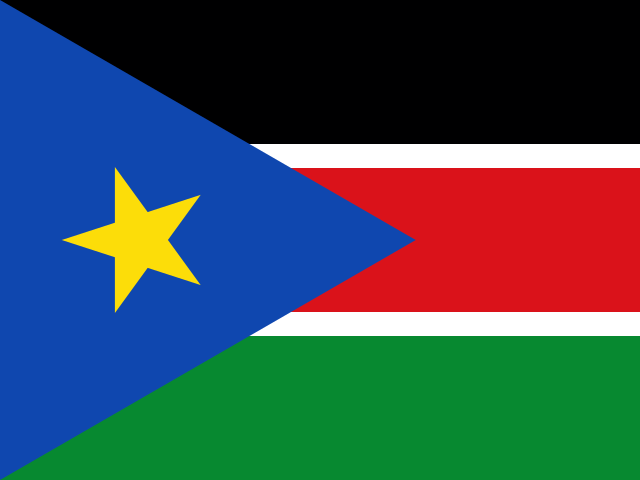
Constitution
The Constitution of South Sudan was adopted in 2011. It is the supreme law of the state. The Constitution sets out the values and principles of organization of the state, establishes the rights, freedoms and obligations of the people, sets up key state institutions and bodies, etc. The Constitution of South Sudan consists of 200 articles that are grouped into fifteen parts, supplemented by 5 schedules.