


The objective of this law is to provide the rules relating to public hygiene and sanitation in rural and urban areas.

The law determines the essential rules relating to public health and hygiene in the Republic of Niger. The law contains articles referring to the fundamental principles of health in Niger, such as the functioning of the national health system, or health information; as well as the fundamental principles of hygiene, such as urban health and food safety.

The document sets up standards to provide guidance to teaching institutions for health professional education and affiliated teaching hospitals and/or second-level teaching hospitals. The health teaching institution must meet the requirements set out in the Standards to obtain accreditation certification and deliver high-quality health professional training.
The document is a check-list that serves as a “road map” for executives for an assessment of health professional colleges and schools in Rwanda.
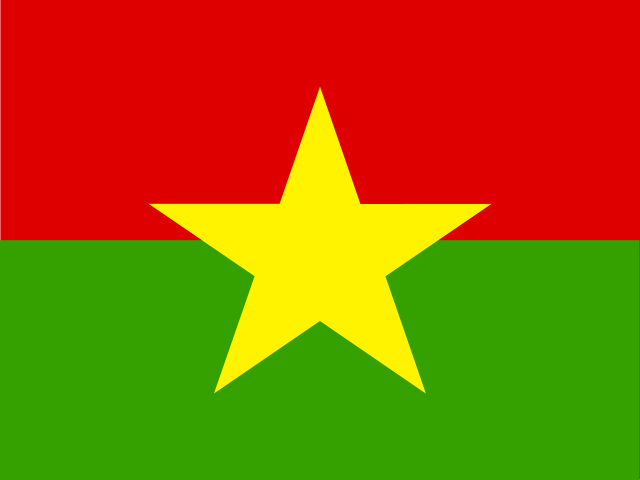
The Decree establishes free access to family planning care and services in Burkina Faso (art.1). These are provided in public health facilities by community health workers (art.2). Private facilities can choose to implement the same, but need to sign an agreement with the Ministry of Health to settle the conditions and modalities (art.3). Specific services covered are to be determined by a joint order from the Ministers responsible for Health and Finances (art.4). These measures are financed by the budget of the State and partners (art. 5) and will be realized progressively (art. 6).

This decree guarantees access to free delivery care in public health facilities.

The Curriculum for the Diploma in Pharmacy are the guidelines for the training and qualification in pharmacy.
This law introduces free healthcare for pregnant women and children under 5 throughout Burkina Faso.

This Decree defines the attributions, the organization and the functioning of the Public Hygiene Police of Mauritania.
This Law defines the rules of public health and hygiene in the Islamic Republic of Mauritania, in particular on public spaces, homes, food and non-food products, water, commercial facilities and industries, educational and health establishments, public buildings, and the natural environment. Its main objective is to preserve and promote public health.
The decree covers the powers, organization and operation of the Public Hygiene Police.

This decree creates a National Training School for State-certified Nurses and Midwives in Anaesthesia - Resuscitation called ENAFISAR. This decree defines the organization and functions of the School, the administrative bodies and commissions, the training requirements, etc.
This law governs public hygiene in Burkina Faso, in particular hygiene on public roads and squares, the hygiene of swimming pools and bathing areas, homes, food products, water, industrial and commercial facilities, schools, pre-schools and health establishments, public buildings and the natural environment, and noise control. Its main objective is to preserve and promote public health.

Lei No 2/77 Determina que todas as acções sanitarias de carácter profilático sejam gratuitas
The law states that all health measures of a prophylactic nature are free of charge. Every citizen has the right to free medical care when they are hospitalized. All complementary diagnostic tests are free of charge both in inpatient and outpatient settings.

The General Health Regulations set out comprehensive guidelines and standards for public health and hygiene, including the control of communicable diseases, sanitation, food safety, and environmental health.