


Refugees Act No 130 of 1998
This Act gives effect within the Republic of South Africa to the relevant international legal instruments, principles and standards relating to refugees; provides for the reception into South Africa of asylum seekers; regulates applications for and recognition of refugee status; provides for the rights and obligations flowing from such status; and provides for matters connected therewith.
Medical Schemes Act No 131 of 1998
The Act consolidates the laws relating to registered medical schemes; provides for the establishment of the Council for Medical Schemes as a juridical entity; provides for the appointment of the Registrar of Medical Schemes; makes provision for the registration and control of certain activities of medical schemes; protects the interests of members of medical schemes; provides for measures for the co-ordination of medical schemes; and provides for incidental matters.

This Act consolidates the law relating to the medical and dental practice and provides for other connected purposes.
The Refugees Act
This Act makes provisions for the Enactment of the Refugees Act, National Eligibility Committee, Asylum seeker and Refugee administration and repeals the Refugee (Control) Act and provides for connected matters.

Medical Services Act, 1998
This Act is to ensure the provision and maintenance of comprehensive hospital services in Zimbabwe; to provide for the admission of persons to Government hospitals and the fixing of fees in respect of services provided thereat; to provide for the granting to medical practitioners and dental practitioners of the privilege of access to certain Government hospitals and for the appointment of consultant medical and dental practitioners; to provide for the registration of medical aid societies; to set conditions for the registration of private hospitals and to provide for matters incidental to or connected with the foregoing.
Loi No 97-013 portant code de la famille
This law establishes a Family Code.

This law provides for the National Order of doctors and specifies its mandate and operating modes.
Constitution
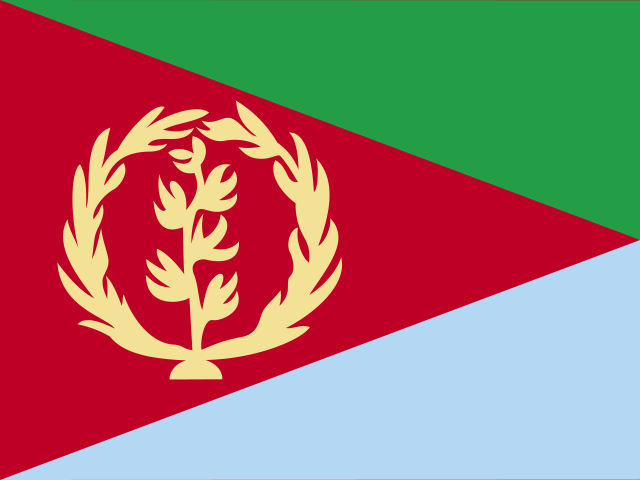
The Constitution of Eritrea includes 59 articles addressing, among others, the State's structure, symbols and languages, the National objectives and directive principles, the fundamental rights, freedoms and duties, the institutions in place including the National Assembly, the Executive power, and the judiciary.

Constitution
The Constitution of the Gambia was adopted in 1997. It is the supreme law of the country and consists of 232 articles that are grouped into 23 chapters. The Constitution sets out the values and principles of the state, defines supremacy rules for the law, proclaims fundamental rights and freedoms, establishes key bodies of the state, etc.

Code de la Santé Publique
The Code provides rules regarding different rears of public health as the prevention and control of communicable diseases; sanitation and housing; and food and water protection among other aspects.

Disaster Management Act 1997
The Act is to establish the Disaster Management Authority; to regulate its powers and functions and to make provision with respect to emergencies arising out of disasters including prevention, mitigation, preparedness, response and recovery measures for the protection of life and property from the effects of disasters.

This Act makes provision for the regulation of the conditions of employment in workplaces as regards the safety, health and welfare of persons employed therein; for the inspection of certain plant and machinery, and the prevention and regulation of accidents occurring to persons employed or authorized to go into the workplaces; and provides for matters connected with or incidental to the foregoing.

The Ordinance provides legislation governing pharmacy. The ordinance regulates the classification of medicines, the registration of medicines, the dispensing of medicines, dietary products, cosmetics, the rules for practicing the profession of pharmacist, the dispensing of medicines by doctors and other aspects.
Code du Travail Loi 97-17
The Labour Code of Senegal contains a compilation of rules governing labour relations and workers rights in Senegal.
The Health Laboratory Technologists Registration Act
This Act provides for the Registration of Health Laboratory Technologists and provides for related matters.
The Private Health Laboratories Regulation Act
The Act regulates the registration and management of private health laboratories managed by approved persons and in respect of private health laboratory services to be rendered by private health laboratories, and related matters.
Constitution
The Constitution of the United Republic of Tanzania was adopted in 1977 and amended in 2005. The Constitution is the supreme law of the country and establishes the state principles, regulates the separation of powers, establishes key government structures and their mandates, establishes rights, etc. The Constitution consists of 152 articles that are organized into ten chapters that are supplemented by two schedules.

The decree N°96-68 addresses the creation, missions, organization and operation of the Inspectorate-General of the Ministry of Health and Population. The text of the decree is provided as part of a compendium of health-related legislation (see pages 22-.24).

This law provides the general framework for the action of the State in the area of health.

The Labor Code governs relations between employers and workers resulting from employment contracts concluded to be performed on the territory of the Republic of Chad regardless of their place of conclusion, residence and nationality of the parties.