


This law, adopted in application of the provisions of Articles 1 and 47 of the Constitution, relates to the protection of personal data.

This Order provides for the creation, organization and operation of the program called the National Health Education Programme.

This Law amends Articles 1, 2, 3, 5, 6, 8, 9, 10, 11, 13, 14, 16, 18, 20, 21, 23, 25, 27, 31, 33, 36, 37, 38, 42, 45, 47, 51, 51, 52, 53, 54, 55, 56, 65, 66, 80 and 86 of the Law No 2020-37 protecting the health of people in the Republic of Benin.

Data Protection Act, 2022
The Act provides for the collection, processing, disclosure, and protection of personal data.

The Public Health Act
This Act repeals and replaces the Public Health Act of 1960, provides for the promotion, protection and improvement of public health and well-being in Sierra Leone, provides for the protection of individuals and communities from public health risks, provides for the prevention and control of the spread of infectious diseases, provides for local government and community participation in protecting public health, provides for early detection and prompt response to diseases and public health threats and provides for other related matters.
The purpose of this law is to organize the protection of the health of the population, and to define the obligations imposed on citizens in the event of communicable, non-communicable, contagious diseases or epidemics. It applies to any person living in the Republic of Benin or entering Benin territory.

Loi n° 001-2021/AN portant protection des personnes à l'égard du traitement des données à caractère personnel
The purpose of the law is to protect the fundamental rights and freedoms of individuals with regard to the processing of their personal data, whatever the nature, method of execution or persons responsible. This law applies to the processing of personal data contained or intended to be contained in a file, whether wholly or partly automated, as well as to non-automated processing of personal data. In particular, it applies to the processing of personal data relating to electronic communications.

The law makes the second amendment to the general legal regime for the protection of personal data of natural persons approved by Law no. 133/V/2001, of January 22, as amended by Law no. 41/VIII/2013, of September 17.

The Law aims at the protection of personal data and privacy and determines their processing.

Data protection Act
This Act provides for data protection measures, and among other things, establishes a Data Protection Authority, provides for their functions, creates a technology-driven business environment and encourages technological development and the lawful use of technology and provides for investigation and collection of evidence of cybercrime and unauthorised data collection and breaches.

This law, published in the Official Journal on 11 June 2020, provides the national legal framework for the security of information systems and electronic communications networks.
The Data Protection (Civil Registration) Regulations were developed in exercise of powers conferred by section 71 of the Data Protection Act, 2019 by the Cabinet Secretary for Information, Communication, Technology, Innovation and Youth Affairs.
This law, published in the Official journal on 7 November 2019, is to put in place a system to ensure the protection of the fundamental rights and freedoms of individuals, in particular their privacy, with regard to the processing of personal data; and to ensure that information and communication technologies remain at the service of the citizen and do not infringe individual freedoms.
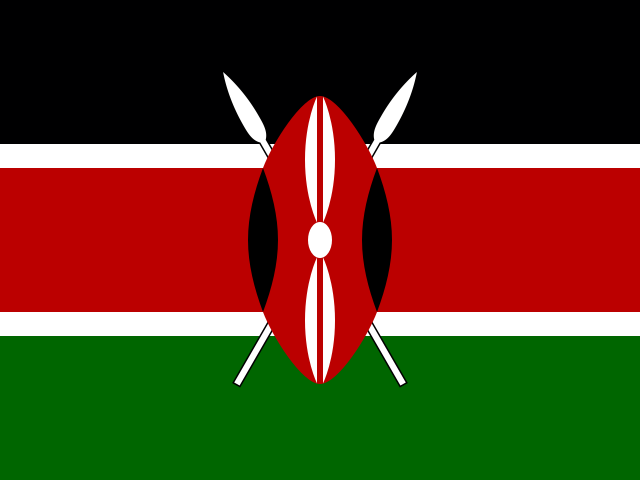
The Data Protection Act
This Act gives effect to Article 31(c) and (d) of the Constitution; establishes the Office of the Data Protection Commissioner; makes provision for the regulation of the processing of personal data; provides for the rights of data subjects and obligations of data controllers and processors; and for connected purposes.

The document is a comprehensive Regulation on data protection in Nigeria. It is a guide to assist data controllers and data administrators/processors in understanding the controls and measures they need to introduce into their operations in order to comply with the Nigeria Data Protection Regulation.

The purpose of the law is to regulate the collection, processing, transmission, storage, use, and protection of personal data.

This Act protects the privacy of the individual and of personal data by regulating the collection and processing of personal information; provides for the rights of the persons whose data is collected and the obligations of data collectors, data processors and data controllers; regulates the use or disclosure of personal information; and provides for related matters.

This Act lays down the fundamental provisions and principles and aims to give concrete form to the rights and duties of the population in matters of health. Its purpose is to ensure the prevention, protection, maintenance, restoration and promotion of people's health. It was published in the Official Journal on 29 July 2018.

Data Protection Act
This Act regulates the protection of personal data and ensures that the privacy of individuals in relation to their personal data is maintained. It also establishes the Information and Data Protection Commission and provides for all matters incidental thereto.

Loi No 18/035 fixant les principes fondamentaux relatifs à l'organisation de la Santé publique
This Law establishes the fundamental principles relating to the organization of public health in the Democratic Republic of the Congo.